Isin-Larsa period
Videos
The Isin-Larsa period is a phase in the history of ancient Mesopotamia, which extends between the end of the Third Dynasty of Ur and the conquest of Mesopotamia by King Hammurabi of Babylon leading to the creation of the First Babylonian dynasty. According to the approximate conventional dating, this period begins in 2025 BCE and ended in 1763 BCE. It constitutes the first part of the Old Babylonian period, the second part being the period of domination of the first dynasty of Babylon, which ends with the Sack of Babylon in 1595 BCE and the rise of the Kassites.

Impression of a cylinder seal. Presentation scene, c. 2000–1750 B.C. Isin-Larsa.

King of Larsa Rim-Sin I foundation figurine, 1822–1763 BCE. Oriental Institute Museum, University of Chicago

Four-faced god, Ishchali, Isin-Larsa to Old Babylonia periods, 2000–1600 BCE, bronze - Oriental Institute Museum, University of Chicago

Title "Rim-Sin, King of Larsa" on the stone bowl: 𒀭𒊑𒅎𒀭𒂗𒍪 Rim-Sin 𒈗 King of 𒌓𒀕 Larsa
Uruk
Videos
Uruk, today known as Warka, was a city in the ancient Near East situated east of the present bed of the Euphrates River on the dried-up ancient channel of the Euphrates. The site lies 93 kilometers northwest of ancient Ur, 108 kilometers southeast of ancient Nippur, and 24 kilometers southeast of ancient Larsa. It is 30 km (19 mi) east of modern Samawah, Al-Muthannā, Iraq.
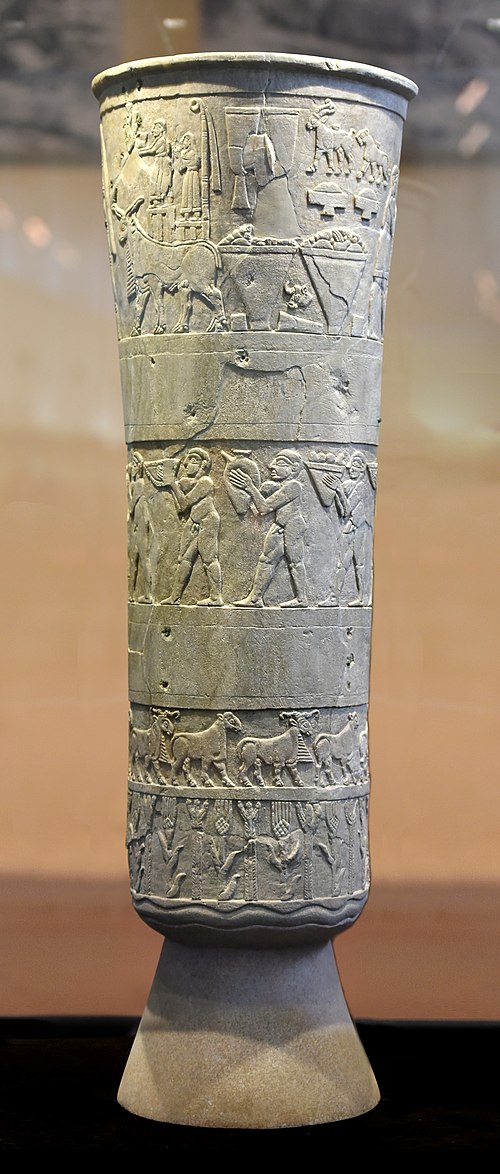

Uruk King priest feeding the sacred herd

An Uruk period cylinder-seal and its impression, c. 3100 BC. Louvre

Partially reconstructed facade and access staircase of the Ziggurat of Ur, originally built by Ur-Nammu, Neo-Sumerian period, circa 2100 BC