Janus (moon)
Videos
Janus is an inner satellite of Saturn. It is named after the mythological Janus, the Roman god of beginnings. This natural satellite was first identified by Audouin Dollfus on December 15, 1966, altho

Janus as imaged by Cassini on 7 April 2010: highest-resolution full-disk image to date

Epimetheus (lower left) and Janus (right) seen on 20 March 2006, two months after swapping orbits. The two moons appear close only because of foreshortening; in reality, Janus is about 40,000 km farther from Cassini than Epimetheus.

Janus as viewed by Voyager 2 (1981-08-25).

Janus and Prometheus lie above and below Saturn's rings (2006-04-29).
Janus
Videos
In ancient Roman religion and myth, Janus is the god of beginnings, gates, transitions, time, duality, doorways, passages, frames, and endings. He is usually depicted as having a double-sided head. Th
Janus (moon)
…Janus is an inner satellite of Saturn. It is named after the mythological Janus, the Roman god of beginnings. This natural satellite was first identified by Audouin Dollfus on December 15, 1966, although it had been unknowingly…
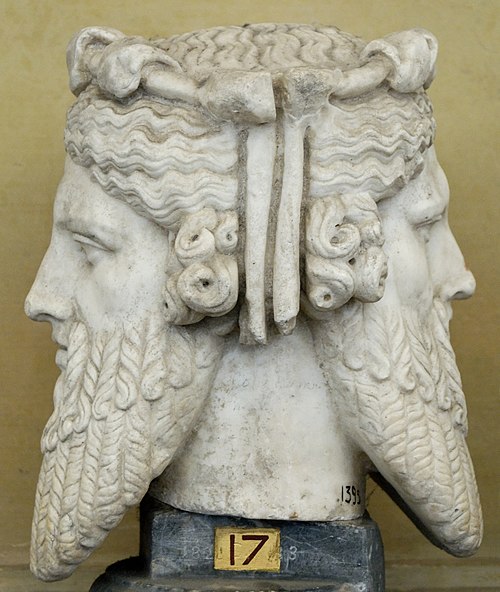
Statue representing Janus Bifrons in the Vatican Museums
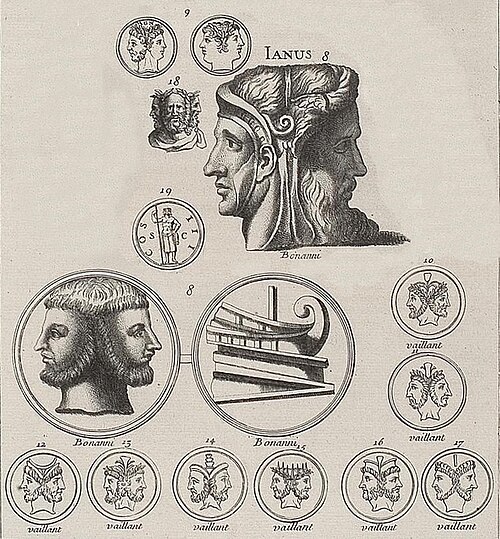
Different depictions of Janus from Bernard de Montfaucon's L'antiquité expliquée et représentée en figures

The temple of Janus with closed doors, on a sestertius issued under Nero in 66 AD from the mint at Lugdunum

The month of January is named after Janus.