Japanese cruiser Tone (1937)
Videos
Tone (利根) was the lead ship in the two-vessel Tone class of heavy cruisers in the Imperial Japanese Navy. The ship was named after the Tone River, in the Kantō region of Japan and was completed on 20 November 1938 at Mitsubishi's Nagasaki shipyards. Tone was designed for long-range scouting missions and had a large seaplane capacity. She was extensively employed during World War II usually providing scouting services to their aircraft carrier task forces. She almost always operated in this capacity in conjunction with her sister ship Chikuma.

Tone in early 1942. Taken from battleship Hiei.

Tone sunk in Etajima Bay
Attack on Pearl Harbor
Videos
The attack on Pearl Harbor was a surprise military strike by the Imperial Japanese Navy Air Service on the American naval base at Pearl Harbor in Honolulu, Hawaii, in the United States, just before 8:00 a.m. on Sunday, December 7, 1941. At the time, the United States was a neutral country in the World War II conflict. The attack on Hawaii and other U.S. territories led the United States to formally enter World War II on the side of the Allies the day following the attack, on December 8, 1941. The Japanese military leadership referred to the attack as the Hawaii Operation and Operation AI, and as Operation Z during its planning.
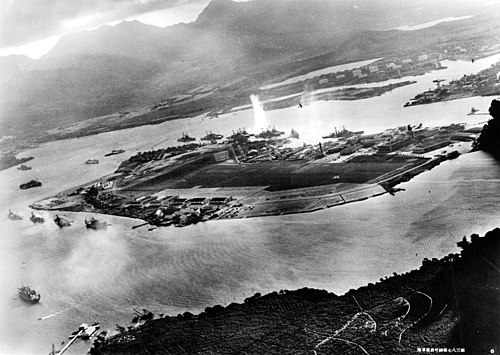
Photograph of Battleship Row taken from a Japanese plane at the beginning of the attack. The explosion in the center is a torpedo strike on USS West Virginia. Two attacking Japanese planes can be seen: one over USS Neosho and one over the Naval Yard.

Pearl Harbor on October 30, 1941, a month prior to the attack, with Ford Island visible (in the center)

The Empire of Japan's 1941 attack plan on Pearl Harbor

The route followed by the Japanese fleet to Pearl Harbor and back