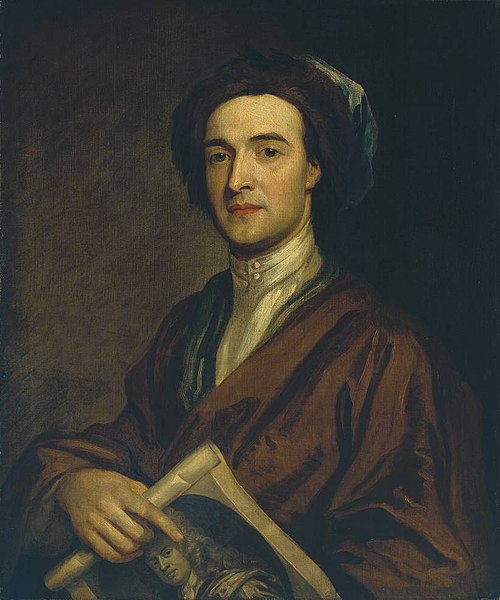
John Smith was an English mezzotint engraver and print seller. Closely associated with the portrait painter Godfrey Kneller, Smith was one of leading exponents of the mezzotint medium during the late 17th and early 18th centuries, and was regarded among first English-born artists to receive international recognition, along the younger painter William Hogarth.
Godfrey Kneller, John Smith, 1696, Tate Britain, London
Loves of the Gods, after Titian
Mezzotint is a monochrome printmaking process of the intaglio family. It was the first printing process that yielded half-tones without using line- or dot-based techniques like hatching, cross-hatching or stipple. Mezzotint achieves tonality by roughening a metal plate with thousands of little dots made by a metal tool with small teeth, called a "rocker". In printing, the tiny pits in the plate retain the ink when the face of the plate is wiped clean. This technique can achieve a high level of quality and richness in the print, and produce a furniture print which is large and bold enough to be framed and hung effectively in a room.
Saint Agnes, mezzotint by John Smith after Godfrey Kneller, usually thought to be a portrait of Kneller's daughter, Catherine Voss, by his mistress
Ludwig von Siegen, Countess Amalie Elisabeth of Hanau-Münzenberg, 1642, is the first known mezzotint, using the light to dark method.
Shirley Jones, 'Eternity', Terra Contigua (2009)
Early mezzotint by Wallerant Vaillant, Siegen's assistant or tutor. Young man reading, with statue of Cupid. Probably made using light to dark technique. 27.5 cm × 21.3 cm (10+13⁄16 in × 8+3⁄8 in)