The K-class blimp was a class of blimps built by the Goodyear Aircraft Company of Akron, Ohio for the United States Navy. These blimps were powered by two Pratt & Whitney Wasp nine-cylinder radial air-cooled engines, each mounted on twin-strut outriggers, one per side of the control car that hung under the envelope. Before and during World War II, 134 K-class blimps were built and configured for patrol and anti-submarine warfare operations, and were extensively used in the Navy’s anti-submarine efforts in the Atlantic and Pacific Ocean areas.
K-class blimp
A color photo of an unidentified Navy K blimp
US Navy sailors attach Mk 47 aerial depth charges to the underside of a K-class blimp at NAS Weeksville, North Carolina in 1944
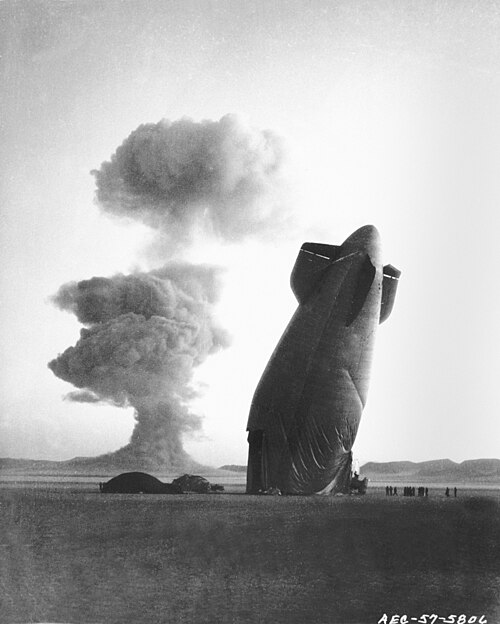
Aftermath of the Plumbbob-Stokes test
A blimp (/blɪmp/), or non-rigid airship, is an airship (dirigible) without an internal structural framework or a keel. Unlike semi-rigid and rigid airships, blimps rely on the pressure of the lifting gas inside the envelope and the strength of the envelope itself to maintain their shape. Blimps are known for their use in advertising, surveillance, and as observation platforms due to their maneuverability and steady flight capabilities.
The Spirit of Goodyear, one of the iconic Goodyear Blimps
Steerable ducted fans on a Skyship 600 provide thrust, limited direction control, and also serve to inflate the ballonets to maintain the necessary overpressure.
A modern blimp from Airship Management Services showing a strengthened nose, ducted fans attached to the gondola under the hull, and cable-braced fins at the tail
Advertising blimp landing at local airport in New Jersey