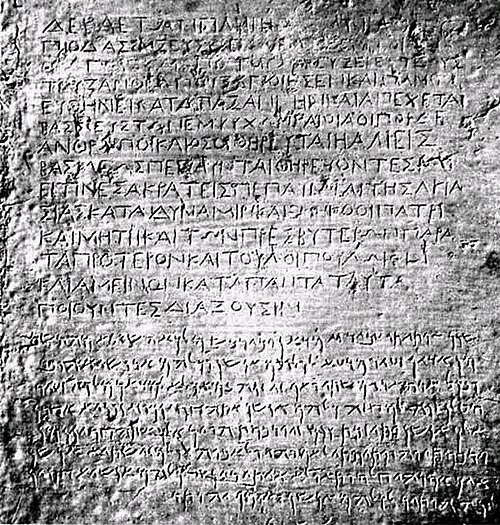
The Kandahar Bilingual Rock Inscription, also known as the Kandahar Edict of Ashoka and less commonly as the Chehel Zina Edict, is an inscription in the Greek and Aramaic languages that dates back to
Bilingual inscription of Ashoka in Greek (top) and Aramaic (bottom) in Afghanistan

Chil Zena ("40 steps") complex, offering a commanding view of Kandahar, and on the mountainside of which the bilingual edict is carved. Chil Zena commands the entrance to the city of Kandahar when coming from the west.

The Kandahar Bilingual Rock Inscription was located at the edge of the Indian realm, near the border with the Greco-Bactrian kingdom and Ai-Khanoum.

An 1881 photo showing the ruined Old Kandahar citadel ("Zor Shar") where the second Greek edict was discovered.
Ashoka
Videos
Ashoka, also known as Asoka or Aśoka, most commonly known as Ashoka the Great, was Emperor of Magadha from c. 268 BCE until his death, and the third ruler from the Mauryan dynasty. His empire covered
Kandahar Bilingual Rock Inscription
…commonly as the Chehel Zina Edict, is an inscription in the Greek and Aramaic languages that dates back to 260 BCE and was carved by the Mauryan emperor Ashoka (r. 268–232 BCE) at Chehel Zina, a mountainous outcrop near Kandahar, Afghanistan. It is among the earliest-known edicts of Ashoka, having been inscribed…

A c. 1st century BCE / CE relief from Sanchi, showing Ashoka on his chariot, visiting the Ramagrama

Ashoka's Major Rock Edict at Junagadh contains inscriptions by Ashoka (fourteen of the Edicts of Ashoka), Rudradaman I and Skandagupta.
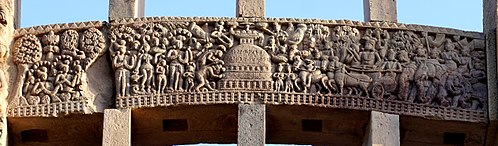
King Ashoka visits Ramagrama, to take relics of the Buddha from the Nagas, but in vain. Southern gateway, Stupa 1, Sanchi.

Ruins of pillared hall at Kumrahar site at Pataliputra