Katabasis
Videos
A katabasis or catabasis is a journey to the underworld. Its original sense is usually associated with Greek mythology and classical mythology more broadly, where the protagonist visits the Greek unde

Odysseus consults the soul of the prophet Tiresias in his katabasis during Book 11 of The Odyssey.

The Cumaean Sibyl leads Aeneas to the Underworld for his katabasis in the Aeneid.

Orpheus travels out of the Underworld followed by the shade of his wife, Eurydice
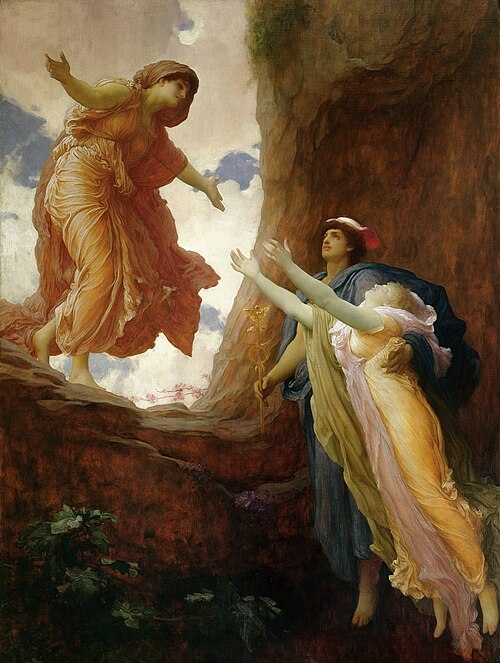
The return of Persephone, by Frederic Leighton (1891)
Aeneid
Videos
The Aeneid is a Latin epic poem that tells the legendary story of Aeneas, a Trojan who fled the fall of Troy and travelled to Italy, where he became the ancestor of the Romans. Written by the Roman po
Manuscript circa 1470, Cristoforo Majorana


Aeneas Flees Burning Troy, by Federico Barocci (1598). Galleria Borghese, Rome, Italy

Paul Cézanne, Aeneas Meeting Dido at Carthage, c. 1875, Princeton University Art Museum

Hawara Papyrus 24, with a line of the Aeneid (repeated 7 times, probably a writing exercise) that translates: "It is not the hated face of Spartan Helen..."). 1st century AD, from Hawara, Egypt; displayed at the British Museum, London