Khasa Kingdom
Videos
The Khasa Kingdom, also known as Khasa-Malla Kingdom, was a medieval kingdom in the Himalayas of South Asia with its capital at Sinja. It was founded by Nāgarāja around the 11th century and lasted unt

Painting of Khasa Buddhist King Ripu Malla and his son Sangrama worshiping the Goddess Tara (center) c. 1312

13th-century inscription by King Ripu Malla on the Nigali Sagar pillar of Ashoka. The inscription reads "Oṃ maṇi padme huṃ" and "Sri Ripumalla Chiram Jayatu 1234" ("Long live Sri Ripumalla"; year 1234 of the Saka Era corresponds to 1312 CE).

Sinja Valley, capital of the Khasa-Mallas

Lumbini pillar inscription by King Ripu Malla: "Om mani padme hum May Prince Ripu Malla be long victorious"
Chand dynasty
Videos
The Chand dynasty was a kingdom that ruled the Kumaon area in present-day Uttarakhand state of India, after the decline of the Katyuri kingdom. At times, their rule also extended to the western parts
Khasa Kingdom
…Abhaya Malla History • Established 11th • Fragmentation into Baise and Chaubisi states 14th century Preceded by Succeeded by Khasas Katyuri dynasty Chand kings Baise Rajya Chaubisi Rajya Tulsipur State Today part of Nepal India China The Khasa Kingdom (Nepali: खस अधिराज्य, romanized: Khasa Adhirājya), also…
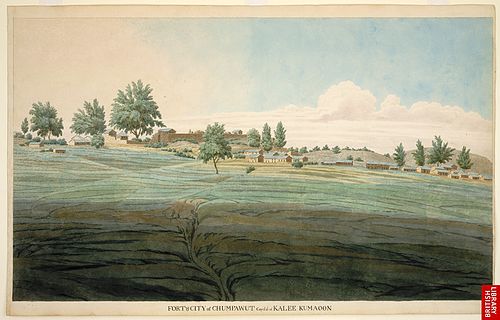
Fort and the capital city of Kali Kumaon, Champawat, 1815.