Khecarī mudrā
Videos
Photos
Khecarī mudrā is a hatha yoga practice carried out by curling the tip of the tongue back into the mouth until it reaches above the soft palate and into the nasal cavity. The tongue is made long enough to do this with many months of daily tongue stretching and, in some versions of the practice, by gradually severing the frenulum of the tongue with a sharp implement over a period of months.

Four stages of Khecarī mudrā. The tongue (red) is progressively stretched, and the frenulum of the tongue (not shown) sufficiently severed, over a period of months, until it can be turned back so as to reach inside the nasal cavity, and supposedly manipulate the flow of bindu.
Hatha yoga
Videos
Photos
Hatha yoga is a branch of yoga that uses physical techniques to try to preserve and channel vital force or energy. The Sanskrit word हठ haṭha literally means "force", alluding to a system of physical techniques. Some hatha yoga style techniques can be traced back at least to the 1st-century CE, in texts such as the Hindu Sanskrit epics and Buddhism's Pali canon. The oldest dated text so far found to describe hatha yoga, the 11th-century Amṛtasiddhi, comes from a tantric Buddhist milieu. The oldest texts to use the terminology of hatha are also Vajrayana Buddhist. Hindu hatha yoga texts appear from the 11th century onward.

Haṭha yoga's components include from top left to bottom right Shatkarmas (purifications, here Nauli), Asanas (postures, here Mayurasana, Peacock Pose), Mudras (manipulations of vital energy, here Viparita Karani), Pranayama (breath control, here Anuloma Viloma).
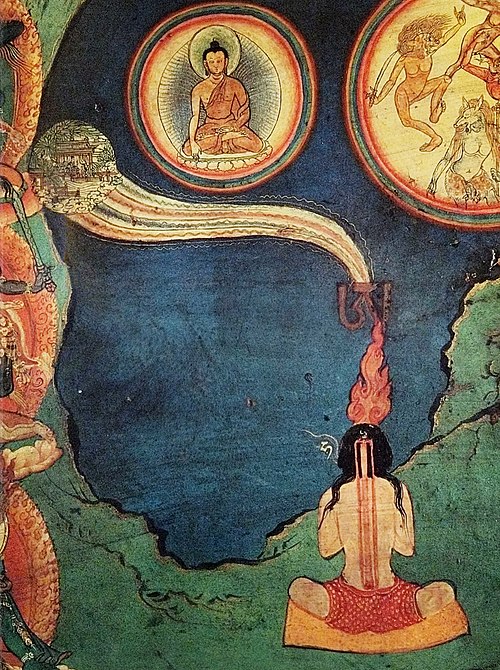
Tibetan depiction of Tummo (candali, inner heat) practice showing the central channel, the sushumna

A folio of a medieval copy of the Amṛtasiddhi, written bilingually in Sanskrit and Tibetan

18th century yoginis in Rajasthan