Kon-Tiki expedition
Videos
The Kon-Tiki expedition was a 1947 journey by raft across the Pacific Ocean from South America to the Polynesian islands, led by Norwegian explorer and ethnographer Thor Heyerdahl. The raft was named

The Kon-Tiki raft at the Kon-Tiki Museum, Oslo

Thor Heyerdahl, the expedition leader, in 2000

National NC-173 radio receiver used by the expedition

A moai
Thor Heyerdahl
Videos
Thor Heyerdahl KStJ was a Norwegian adventurer and ethnographer with a background in biology with specialization in zoology, botany and geography.
Kon-Tiki expedition
…expedition was a 1947 journey by raft across the Pacific Ocean from South America to the Polynesian islands, led by Norwegian explorer and ethnographer Thor Heyerdahl. The raft was named Kon-Tiki after the Inca god Viracocha, for whom "Kon-Tiki" was said to be an old name. Heyerdahl's book on the expedition was…

Heyerdahl c. 1980
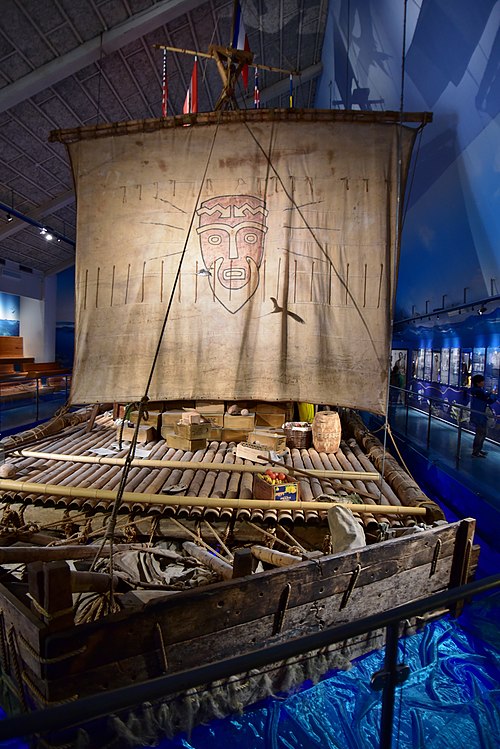
The Kon-Tiki in the Kon-Tiki Museum in Oslo, Norway

Thor Heyerdahl, in 1955

The Hōkūleʻa, a performance-accurate replica of a Polynesian double-hulled wa'a kaulua voyaging canoe, sailed from Hawaiʻi to Tahiti against prevailing winds in 1976, partly to disprove Heyerdahl's drift hypothesis on his much more primitive and unsteerable Kon-Tiki balsa raft