Kurgan stelae
Videos
Kurgan stelae, or balbals are anthropomorphic stone stelae, images cut from stone, installed atop, within or around kurgans, in kurgan cemeteries, or in a double line extending from a kurgan. The stel
"La Dame de Saint-Sernin", southern France, 3100-2900 BC.


Anthropomorphic stele of the early type (Neolithic period) from Hamangia-Baia, Romania exhibited at Histria Museum

Stele #25 from the Petit Chasseur in Sion, Switzerland, dating from 2700–2150 BC

The "Oldest Kurgan stelae in Mongolia", circa 2500-2000 BCE: Chemurchek culture standing stone (Yagshiin khodoo 3). 46°07′18″N 91°34′18″E / 46.1218°N 91.5718°E / 46.1218; 91.5718
Kipchaks
Videos
The Kipchaks, also spelled Qipchaqs, known as Polovtsians in Russian sources, were Turkic nomads and then a confederation that existed in the Middle Ages inhabiting parts of the Eurasian Steppe.
Kurgan stelae
…Aryan migration event. European traveler William of Rubruck mentioned them for the first time in the 13th century, seeing them on kurgans in the Cuman (Kipchak) country, he reported that Cumans installed these statues on tombs of their deceased. These statues are also mentioned in the 17th-century "Large Drawing…

A Safavid depiction of the Padishah (Emperor) of Dast-i Qipchaq ("Steppe of the Kipchaks"). Tabriz or Qavin, circa 1550. British Museum, Padishah (Emperor) of Dast-i Qipchaq, (1550). Possible portrait of Kazakh khan

Kipchak portrait in a 12th-century balbal in Luhansk.
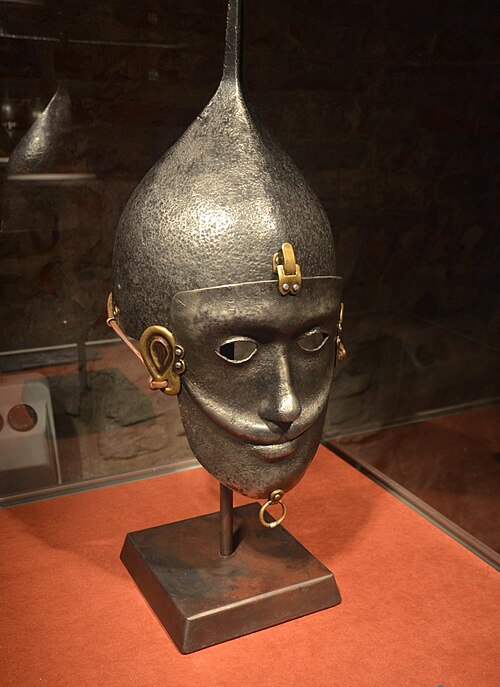
Reproduction of a 13-14th century Tatar helmet and mask found in Lipovets, without a chainmail aventail.

Facial reconstruction of Kipchak from 14th-century grave