Lander (spacecraft)
Videos
A lander is a spacecraft that descends towards, then comes to rest on the surface of an astronomical body other than Earth. In contrast to an impact probe, which makes a hard landing that damages or d
The lunar surface through the Apollo 16 Lunar Module window shortly after landing


Surveyor 3 on the Moon

Surface of Saturn's moon Titan as seen by the Huygens probe after landing in 2005
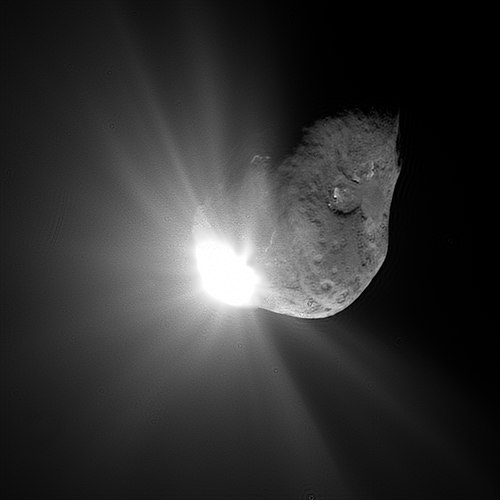
The collision of comet 9P/Tempel and the Deep Impact probe
Moon
Videos
The Moon is the only natural satellite of Earth. It orbits around Earth at an average distance of 384,399 kilometers, a distance roughly 30 times the width of Earth. It completes an orbit in relation
Lander (spacecraft)
…impact, the spacecraft is called an impactor. Several terrestrial bodies have been subject to lander or impactor exploration. Among them are Earth's Moon; the planets Venus, Mars, and Mercury; Saturn's moon Titan; asteroids; and comets. Beginning with Luna 2 in 1959, the first few spacecraft to reach the…

The near side of the Moon with the lunar north pole at the top

Size comparison of the main moons of the Solar System with Earth to scale. Nineteen moons are large enough to be round, several having subsurface oceans and one, Titan, having a considerable atmosphere.

Surveyor 7 observes levitating dust, a phenomenon named Lunar horizon glow can be seen

Astronaut Charles Duke working on the Moon with his suit covered in lunar dust. Lunar dust is highly abrasive and can cause damage to human lungs and nervous and cardiovascular systems.