Le Diable à quatre (ballet)
Videos
Le Diable à quatre is a ballet in two acts and three scenes, with choreography by Joseph Mazilier, music by Adolphe Adam, and libretto by Adolphe de Leuven, first presented by the Ballet of the Académ

Frontispiece from a piano reduction of pieces taken from the Mazilier/Adam Le Diable à quatre, 1845. The frontispiece depicts, from left to right, Lucien Petipa, Jean Coralli, Carlotta Grisi, Maria Mazilier, and Joseph Mazilier.

Aleksander Tarnowski as the Count and Konstancja Turczynowicz as the Peasant, 1847

Marie Surovshchikova-Petipa as Mazourka, St. Petersburg, 1861

Act II-Scene 3, with Carlotta Grisi and Lucien Petipa, Paris, 1845
Romantic ballet
Videos
The Romantic ballet is defined primarily by an era in ballet in which the ideas of Romanticism in art and literature influenced the creation of ballets. The era occurred during the early to mid 19th c
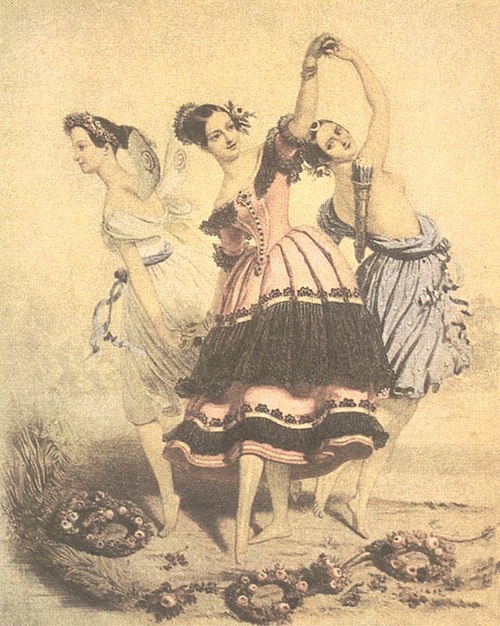
The Three Graces: embodiment of the Romantic ballet, ca. 1840. This lithograph by A. E. Chalon depicts three of the greatest ballerinas in three of the era's defining roles: (left to right) Marie Taglioni as the Sylph in Filippo Taglioni's 1832 ballet La Sylphide; Fanny Elssler as Florinda in the dance La Cachucha from Jean Coralli's 1836 ballet Le Diable boiteux; and Carlotta Grisi as Béatrix in the Grand pas de Diane chasseresse from Albert's 1842 ballet

Lithograph by A. E. Chalon of Carlotta Grisi (left), Marie Taglioni (center), Lucille Grahn (right back), and Fanny Cerrito (right front) in the Perrot/Pugni Pas de Quatre, London, 1845. The premiere of the Pas de Quatre is considered to be the Romantic ballet at its zenith.

A romantic tutu