Lions Gate Bridge
Videos
The Lions Gate Bridge, opened in 1938 and officially known as the First Narrows Bridge, is a suspension bridge that crosses the first narrows of Burrard Inlet and connects the City of Vancouver, British Columbia, to the North Shore municipalities of the District of North Vancouver, the City of North Vancouver, and West Vancouver. The term "Lions Gate" refers to the Lions, a pair of mountain peaks north of Vancouver. Northbound traffic on the bridge heads in their general direction. A pair of cast concrete lions, designed by sculptor Charles Marega, were placed on either side of the south approach to the bridge in January 1939.

Viewed from North Vancouver in 2002

May 1934: Signing the First Narrows Bridge agreement

Lions Gate Bridge under construction, 1938

Lions Gate Bridge suspended structure replacement, April 2001
Suspension bridge
Videos
A suspension bridge is a type of bridge in which the deck is hung below suspension cables on vertical suspenders. The first modern examples of this type of bridge were built in the early 1800s. Simple suspension bridges, which lack vertical suspenders, have a long history in many mountainous parts of the world.

The 1915 Çanakkale Bridge on the Dardanelles strait in Turkey, connecting Europe and Asia, is the longest suspension bridge in the world.

The double-decked George Washington Bridge, connecting New York City to Bergen County, New Jersey, is the world's busiest suspension bridge, carrying 106 million vehicles annually.

Chushul Chakzam, one of Thangtong Gyalpo's chain bridges, in 1904
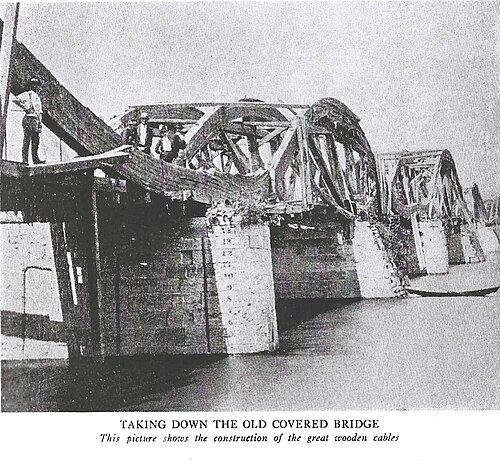
The wooden 1808 Burr Suspension Bridge in Schenectady, NY, USA, during demolition in 1871, showing wooden cables. Spans of 160, 190, 180 and 157 feet on 3 piers began to sag, and 4 supporting piers were added in 1833 making 8 spans.