Suspension bridge
Videos
A suspension bridge is a type of bridge in which the deck is hung below suspension cables on vertical suspenders. The first modern examples of this type of bridge were built in the early 19th century.

The 1915 Çanakkale Bridge on the Dardanelles strait in Turkey, connecting Europe and Asia, is the suspension bridge with the longest main span in the world.

The double-decked George Washington Bridge, connecting New York City to Bergen County, New Jersey, is the world's busiest suspension bridge by traversing vehicles, carrying 106 million vehicles annually.

Chushul Chakzam, one of Thangtong Gyalpo's chain bridges, in 1904
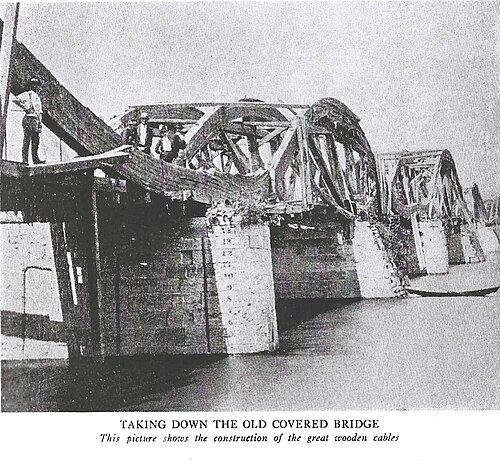
The wooden 1808 Burr Suspension Bridge in Schenectady, NY, US, during demolition in 1871, showing wooden cables. Spans of 160, 190, 180 and 157 feet on 3 piers began to sag, and 4 supporting piers were added in 1833, making 8 spans.
1915 Çanakkale Bridge
Videos
The 1915 Çanakkale Bridge is a road suspension bridge in the province of Çanakkale in northwestern Turkey, first opened on 18 March 2022. Situated just southwest of the coastal towns of Lapseki and Ge
Suspension bridge
…Si Du River Bridge (China, 2009), the highest bridge in the world, with its deck around 500 meters above the surface of the river. 1915 Çanakkale Bridge (Turkey, 2022), has the longest main span of any suspension bridge in the world, crosses the Dardanelles, has a main span of 2,023 meters. Broughton…

Çanakkale bridge in September 2025

Western tower, March 2020

The bridge near completion

1915 Çanakkale Bridge Commemorative Coin