Lithuania
Videos
Lithuania, officially the Republic of Lithuania, is a country in the Baltic region of Europe. It is one of three Baltic states and lies on the eastern shore of the Baltic Sea, bordered by Latvia to th

Earliest mention of Lithuania (Litua, on line 7) in the entry for 1009 in the 11th-century Annals of Quedlinburg, Dresden, Sächsische Landesbibliothek, Q.113, fol 31r.

Baltic amber was a valuable trade item, transported from the region of modern-day Lithuania to the Roman Empire through the Amber Road.

Ancient Kernavė hillforts

Trakai Island Castle, the former residence of the Grand Dukes of Lithuania. Nearby Senieji Trakai was the capital of the medieval state in 1316–1323, before the Lithuanian capital was transferred to Vilnius by the Lithuanian monarch Gediminas.
Lithuanian language
Videos
Lithuanian is an East Baltic language belonging to the Baltic branch of the Indo-European language family. It is the language of Lithuanians and the official language of Lithuania as well as one of th
Lithuania
…cities include Kaunas, Klaipėda, Šiauliai and Panevėžys. Lithuanians are the titular nation, belong to the ethnolinguistic group of Balts, and speak Lithuanian. For millennia, the southeastern shores of the Baltic Sea were inhabited by various Baltic tribes. In the 1230s, Lithuanian lands were united for the…
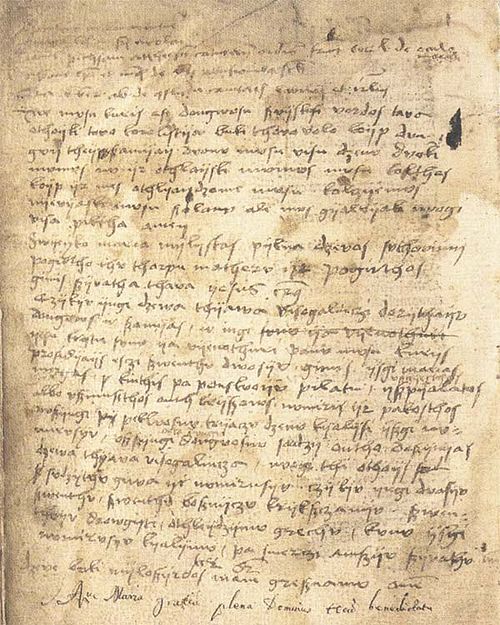
The oldest surviving manuscript in Lithuanian (c. 1503), rewritten from a 15th century original text.

Lithuanian primer for children Moksłas skaytima raszta lietuwiszka, published in Lithuania's capital Vilnius in 1783

Lithuanian school in Vilnius in 1902

Ethnolinguistic area of Lithuanians and the Lithuanian language in 1917 by Prussian Lithuanian professor Vilius Gaigalaitis (Wilhelm Gaigalat), the dashed areas represent linguistically mixed border areas where Lithuanians formed a large minority