Louis Brownlow was an American author, political scientist, and consultant in the area of public administration. As chairman of the Committee on Administrative Management in 1937, he co-authored a report which led to passage of the Reorganization Act of 1939 and the creation of the Executive Office of the President. While chairing the Committee on Administrative Management, Brownlow called several of President Franklin D. Roosevelt's advisors men with "a passion for anonymity"—which later became a popular phrase.</ref>
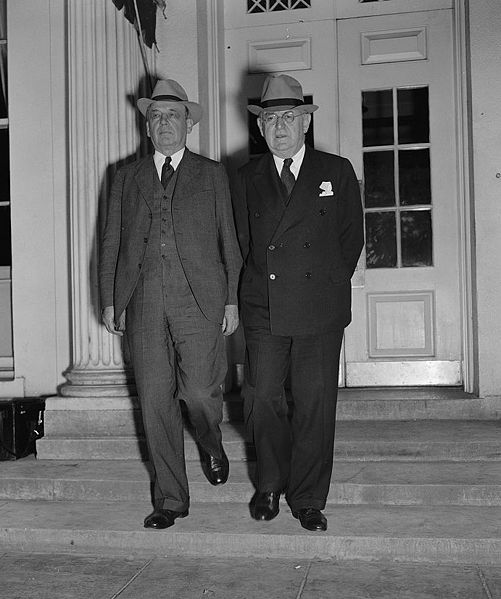
Charles Merriam (left) and Louis Brownlow at the White House in 1938
Brownlow's former residence in the Dupont Circle neighborhood of Washington, D.C.
Public administration, or public policy and administration, is the academic discipline that studies how public policy is created and implemented. It is also a subfield of political science that studies policy processes and the structures, functions, and behavior of public institutions and their relationships with broader society. The study and application of public administration is founded on the principle that the proper functioning of an organization or institution relies on effective management.
Public administration is both an academic discipline and a field of practice; the latter is depicted in this picture of U.S. federal public servants at a meeting.
Administrators tend to work with both paper documents and computer files: "There has been a significant shift from paper to electronic records during the past two decades. Although government institutions continue to print and maintain paper documents as 'official records,' the vast majority of records are now created and stored in electronic format." Pictured here is Stephen C. Dunn, Deputy Comptroller for the US Navy.
Woodrow Wilson
Luther Gulick (1892–1993) was an expert on public administration.