Low-water crossing
Videos
A low-water crossing is a low-elevation roadway traversing over a waterbody that stays dry above the water when the flow is low, but is designed to get submerged under high-flow conditions such as floods. This type of crossing is much cheaper to build than a high bridge that keeps the road surface consistently above the highest water level, and is usually deployed in semi-arid areas where high-volume rainfall is rare and the existing channel is shallow, particularly in developing countries.

A low-water crossing in Fargo, North Dakota, United States of America during a routine flooding event on the Red River of the North. The water level was at 29.5', just below the threshold for a major flood as defined by the National Weather Service.

Low-water crossing (vented ford) at Chew Stoke, Somerset, United Kingdom
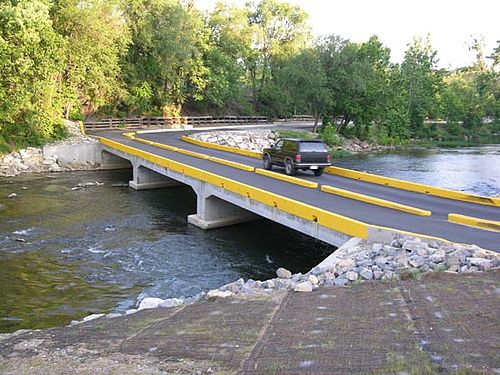
Roanoke River low water bridge, USA

The drovers' road from Abergwesyn to Tregaron, Wales, United Kingdom, crosses the Afon Irfon via the Irish bridge at the foot of the Devil's Staircase
Ford (crossing)
Videos
A ford is a shallow place with good footing where a river or stream may be crossed by wading, or inside a vehicle getting its wheels wet. A ford may occur naturally or be constructed. Fords may be impassable during high water. A low-water crossing is a low bridge that allows crossing over a river or stream when water is low but may be treated as a ford when the river is high and water covers the crossing.

Rawney Ford on the Bothrigg Burn, a tributary of the White Lyne in Cumbria, England
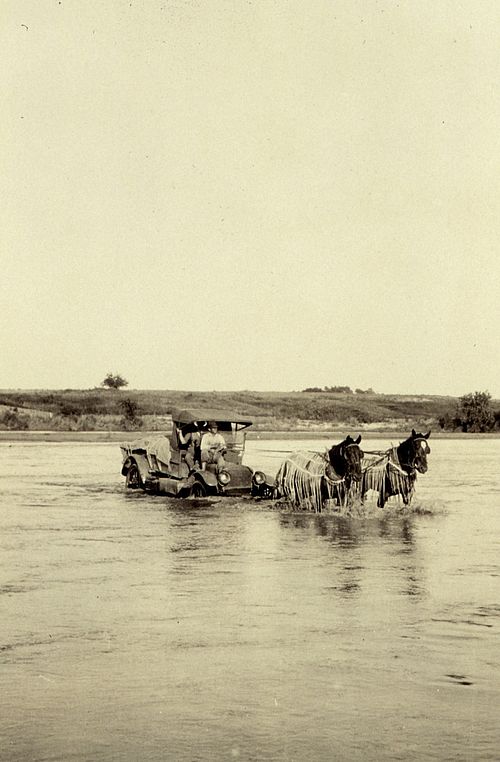
Crossing the Red River near Granite, Oklahoma in 1921

Crossing the Milkhouse ford through Rock Creek in 1960

A ford next to a bridge that can only support 1.5 tonnes in Aufseß, Germany