Lunar mare
Videos
Lunar maria are large, dark, basaltic plains on Earth's Moon, formed by lava flowing into ancient impact basins. They are less reflective than the "highlands" as a result of their iron-rich compositio

Lunar basalt layering exposed

Ancient rift valleys – context.

Ancient rift valleys – closeup (artist's concept).

Irregular mare patch – evidence of young lunar volcanism (12 October 2014)
Far side of the Moon
Videos
The far side of the Moon, also called the dark side of the Moon, is the hemisphere of the Moon that faces away from Earth; the opposite hemisphere being the near side. Due to tidal locking, the time i
Lunar mare
…and hence appear dark to the naked eye. The maria cover about 16% of the lunar surface, mostly on the side visible from Earth. The few maria on the far side are much smaller, residing mostly in very large craters. The term "mare" (sea) was used in astronomy in the beginnings of the 17th century, initially…

The ground surface of the lunar far side with the Yutu-2 rover (center), captured by the Chang'e 4 lander.

Detailed view with Mare Moscoviense visible, by the Lunar Reconnaissance Orbiter (LRO)
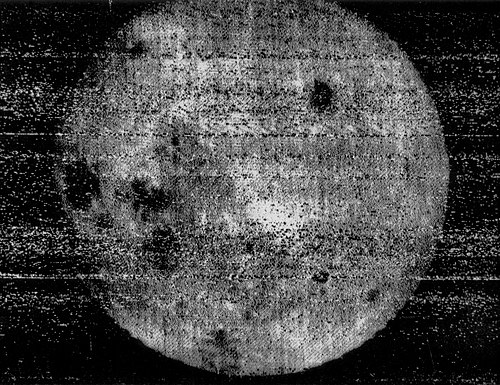
The 7 October 1959 image by Luna 3, which revealed for the first time the far side of the Moon. Clearly visible is Mare Moscoviense (top right) and a mare triplet of Mare Crisium, Mare Marginis and Mare Smythii (left center).

The far side of the Moon, with Mare Marginis and Mare Smythii visible, photographed by Apollo 16 in 1972. It is much more cratered than the near side of the Moon.