M. Stanley Livingston
Videos
Milton Stanley Livingston was an American accelerator physicist, co-inventor of the cyclotron with Ernest Lawrence, and co-discoverer with Ernest Courant and Hartland Snyder of the strong focusing principle, which allowed development of modern large-scale particle accelerators. He built cyclotrons at the University of California, Cornell University and the Massachusetts Institute of Technology. During World War II, he served in the operations research group at the Office of Naval Research.


M. Stanley Livingston (L) and Ernest O. Lawrence next to a 27-inch cyclotron at the Radiation Laboratory in 1934.
Cyclotron
Videos
A cyclotron is a type of particle accelerator invented by Ernest Lawrence in 1929–1930 at the University of California, Berkeley, and patented in 1932. A cyclotron accelerates charged particles outwards from the center of a flat cylindrical vacuum chamber along a spiral path. The particles are held to a spiral trajectory by a static magnetic field and accelerated by a rapidly varying electric field. Lawrence was awarded the 1939 Nobel Prize in Physics for this invention.

Lawrence's 60-inch (152 cm) cyclotron, c. 1939, showing the beam of accelerated ions (likely protons or deuterons) exiting the machine and ionizing the surrounding air causing a blue glow

Lawrence's original 4.5-inch (11 cm) cyclotron
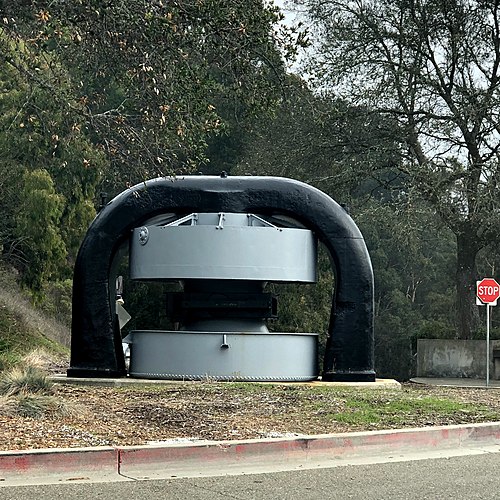
The magnet yoke for the 37-inch (94 cm) cyclotron on the grounds of the Lawrence Hall of Science, Berkeley, California

Vacuum chamber of Lawrence 69 cm (27 in) 1932 cyclotron with cover removed, showing the dees. The 13,000 V RF accelerating potential at about 27 MHz is applied to the dees by the two feedlines visible at top right. The beam emerges from the dees and strikes the target in the chamber at bottom.