MAVEN
Videos
MAVEN is a NASA spacecraft orbiting Mars to study the loss of that planet's atmospheric gases to space, providing insight into the history of the planet's climate and water. The name is an acronym for "Mars Atmosphere and Volatile Evolution" while the word maven also denotes "a person who has special knowledge or experience; an expert". MAVEN was launched on an Atlas V rocket from Cape Canaveral Air Force Station, Florida, on 18 November 2013 UTC and went into orbit around Mars on 22 September 2014 UTC. The mission is the first by NASA to study the Mars atmosphere. The probe is analyzing the planet's upper atmosphere and ionosphere to examine how and at what rate the solar wind is stripping away volatile compounds.
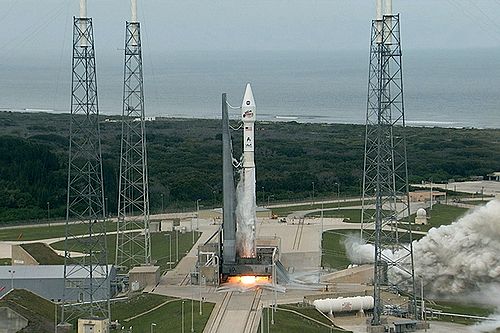
MAVEN – Atlas V ignition (18 November 2013)

MAVEN aerobraking to a lower orbit – in preparation for the Mars 2020 mission (February 2019)

MAVEN's Electra UHF radio transceiver

Solar Wind Electron Analyzer (SWEA) measures solar wind and ionosphere electrons.
Atmosphere of Mars
Videos
The atmosphere of Mars is the layer of gases surrounding Mars. It is primarily composed of carbon dioxide (95%), molecular nitrogen (2.85%), and argon (2%). It also contains trace levels of water vapor, oxygen, carbon monoxide, hydrogen, and noble gases. The atmosphere of Mars is much thinner and colder than Earth's having a max density 20g/m3 with a temperature generally below zero down to -60 Celsius. The average surface pressure is about 610 pascals (0.088 psi) which is less than 1% of the Earth's value.

Mars's escaping atmosphere—carbon, oxygen, hydrogen—measured by MAVEN's UV spectrograph).

Seasonal variations of oxygen at Gale crater

Clouds captured by NASA's Curiosity rover

Seasonal variations in oxygen and methane at Gale crater