Mandaic language
Videos
Mandaic, or more specifically Classical Mandaic, is the liturgical language of Mandaeism and a South Eastern Aramaic variety in use by the Mandaean community, traditionally based in southern parts of

Incantation bowl from Mesopotamia dated between the 5th and the 8th century, inscribed in Mandaic, in the collection of the Jewish Museum of Switzerland
Aramaic
Videos
Aramaic is a Northwest Semitic language that originated in the ancient region of Syria and quickly spread to Mesopotamia, the southern Levant, Sinai, southeastern Anatolia, the Caucasus, and Eastern A
Mandaic language
…Iran: Khuzistan Ethnicity Mandaeans Native speakers (5,500 cited 2001–2006) Language family Afro-Asiatic Semitic Central Semitic Northwest Semitic Aramaic Eastern Southeastern Mandaic Early forms Proto-Afroasiatic Proto-Semitic Old Aramaic Middle Aramaic Eastern Middle Aramaic Writing system Mandaic…

The Carpentras Stele was the first ancient inscription ever identified as "Aramaic". Although it was first published in 1704, it was not identified as Aramaic until 1821, when Ulrich Friedrich Kopp complained that previous scholars had left everything "to the Phoenicians and nothing to the Arameans, as if they could not have written at all".

This clay tablet represents a classroom experiment; a teacher imposed a challenging writing exercise on pupils who spoke both Babylonian-Akkadian and Aramaic. The pupils had to use traditional syllabic signs to express the sounds of the Aramaic alphabet. c. 500 BC. From Iraq

One of the Bar-Rakib inscriptions from Sam'al. The inscription is in the Samalian language (also considered a dialect).
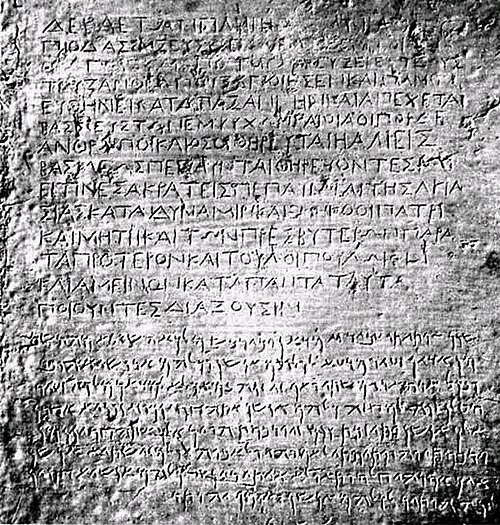
The Kandahar Bilingual Rock Inscription (Greek and Aramaic) by the Indian king Ashoka, 3rd century BC at Kandahar, Afghanistan