Marc Mitscher
Videos
Marc Andrew "Pete" Mitscher was a pioneer in naval aviation who became an admiral in the United States Navy, and served as commander of the Fast Carrier Task Force in the Pacific during World War II.
Marc A. Mitscher, then a vice admiral (c. 1944–45)


Naval aviator Marc A. Mitscher, circa 1916. Mitscher was among the first naval aviators.

Crew of the N.C-1 from left to right: Lieutenant-Commander P. N. L. Bellinger, commander; Lieut.-Commander M. A. Mitscher, pilot; Lieut. J. T. Barin, pilot; Lieut. (j.g.) Harry Sodenwater, radio operator; Chief Machinist's Mate C. I. Kessler, engineer; Machinist Rasmus Christensen, reserve pilot engineer

Lt. Colonel James Doolittle and Captain Marc Mitscher on board USS Hornet.
Battle of the Philippine Sea
Videos
The Battle of the Philippine Sea was a major naval battle of World War II on 19–20 June 1944 that eliminated the Imperial Japanese Navy's ability to conduct large-scale carrier actions. It took place
Marc Mitscher
…not be conducted in the face of land-based air power was brushed aside. In the ensuing year Mitscher's aviators attacked Japanese carrier forces in the Battle of the Philippine Sea—also known as the "Great Marianas Turkey Shoot"—during June 1944. When a very long-range U.S. Navy follow-up strike had to return to their carriers in…

The carrier Zuikaku (center) and two destroyers under attack by U.S. Navy carrier aircraft, 20 June 1944
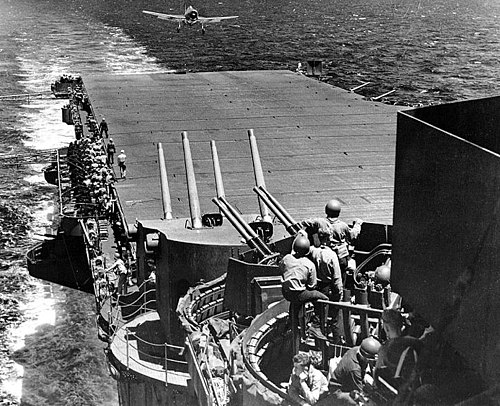
F6F-3 landing aboard Lexington, flagship of Task Force 58

Fighter aircraft contrails mark the sky over Task Force 58, 19 June 1944

Yokosuka D4Y1 Suisei Model 11 "Judy" dive-bomber of the 652nd Kōkūtai (Air Group) taking off from the aircraft carrier Jun'yō during the Battle of Philippine Sea (19 June 1944). This aircraft was part of Jun'yō's second wave that was launched at 10:30 am on 19 June 1944, which consisted of 9 D4Y1s escorted by 6 A6M5s.