In neuroanatomy, the medullary pyramids are paired white matter structures of the brainstem's medulla oblongata that contain motor fibers of the corticospinal and corticobulbar tracts – known together

Pons and medulla oblongata. Anterior surface. (Pyramids visible at center.)
This article describes anatomical terminology that is used to describe the central and peripheral nervous systems - including the brain, brainstem, spinal cord, and nerves.

The anatomical axes of orientation of the human brain are at odds with the anatomical axes of the human body in the standard anatomical position. Red axis shows how the head bent forward as the back pointed upwards: c: Caudal r: Rostral Yellow axes show the conventions for naming directions in the brain itself: c: Caudal (though not tail direction), d: Dorsal r: Rostral (effectively unchanged) v: Ventral (though not belly direction)
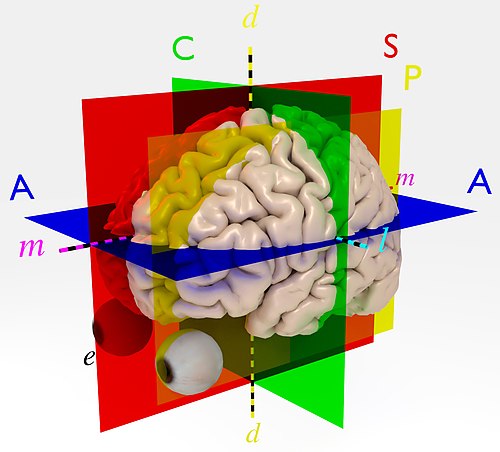
Anatomical axes, planes and localisations in the human brain. Three axes: d: Axial, Superior-inferior or Dorsoventral axis (yellow) l: Left-right, or Lateral axis (cyan, blue-green) m: Median, Antero-posterior or Rostral-to-caudal axis (magenta) Three major planes: A: Axial (blue), containing the lateral axis and also the Medial axis C: Coronal plane (green), containing the axial axis and the lateral axis S: Sagittal plane (red), containing the axial axis and the medial axis Also:

The optic chiasm in the human brain, showing pathways conveying information from the visual field of each eye to the contralateral visual cortex

Image of the human brain showing sulci, gyri, and fundi shown in a Coronal section.