Melodrama (film genre)
Videos
In film studies and criticism, melodrama may variously refer to a genre, mode, style or sensibility characterized by its emphasis on intense and exaggerated emotions and heightened dramatic situations

Rock Hudson and Jane Wyman in All That Heaven Allows (1955) by Douglas Sirk, a paradigmatic melodrama film.

Joan Crawford in Mildred Pierce (1945), one of the few films called a "melodrama" in its pre-1970s and post-1970s conception.

The standard definition of melodrama as a film genre was born out of a reappraisal of director Douglas Sirk, who was recognized as the major exponent of the style.

Karin Dicker, Juanita Moore, Terry Burnham and Lana Turner in Sirk's Imitation of Life (1959), an archetypal melodrama in which the female protagonist suffers recurring crises stemming from repressive societal expectations.
Melodrama
Videos
A melodrama is a dramatic work in which plot, typically sensationalized for a strong emotional appeal, takes precedence over detailed characterization. Melodrama is "an exaggerated version of drama".
Melodrama (film genre)
…from the Greek words mélos (music) and dráma. In a broader sense, several film scholars have traced the historical origins of film melodrama in the theatrical genre of the same name, which enjoyed great popularity during the Victorian era. "Melodrama owes its longevity to the fact that it has existed–and continues to exist–as a…
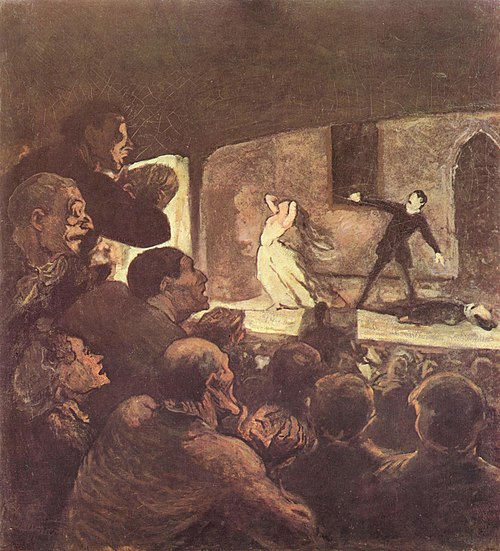
Mélodrame, painted by Honoré Daumier between 1855 and 1860, depicting a typical Parisian scene on Boulevard du Temple

Poster for The Perils of Pauline (1914), a classic melodramatic film series