Messier 81
Videos
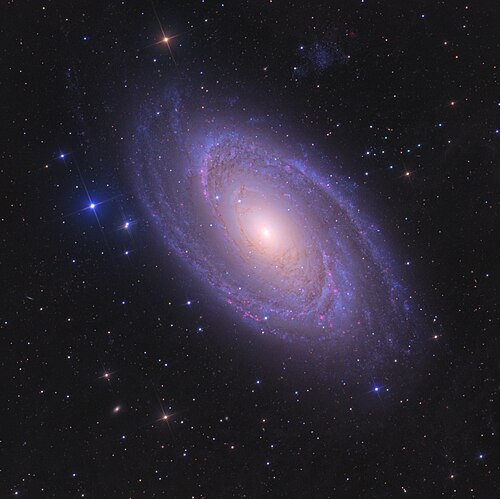
Messier 81 is a grand design spiral galaxy about 12 million light-years away in the constellation Ursa Major. It has a D25 isophotal diameter of 29.44 kiloparsecs.

The HST's view of M81, with its open star clusters, globular star clusters, and regions of fluorescent gas.

An infrared image of Messier 81 taken by the Spitzer Space Telescope. The blue colors represent stellar emission observed at 3.6 μm. The green colors represent 8 μm emission originating primarily from polycyclic aromatic hydrocarbons in the interstellar medium. The red colors represent 24 μm emission originating from heated dust in the interstellar medium.

M81 (left) and M82 (right). M82 is one of two galaxies strongly influenced gravitationally by M81. The other, NGC 3077, is located off the top edge of this image.
M81 with satellite galaxy Holmberg IX, shown top center-right.
Andromeda Galaxy
Videos
The Andromeda Galaxy is a barred spiral galaxy and is the nearest major galaxy to the Milky Way. It was originally named the Andromeda Nebula and is cataloged as Messier 31, M31, and NGC 224. Andromed
Messier 81
…of 8.5 ± 1.3 Mly (2.6 ± 0.4 Mpc) to Messier 81. As a local galaxy, the Central Bureau for Astronomical Telegrams (CBAT) tracks novae in M81 along with M31 and M33. In the center of M81 there exists a supermassive black hole (SMBH) with a mass of about 7×10⁷ M☉. The SMBH is active, having an accretion disk…

The earliest known photograph of the Great Andromeda "Nebula" (with M110 to the upper right), by Isaac Roberts (29 December 1888)

Largest Mosaic of Andromeda by Hubble with details: (a) Clusters of bright blue stars embedded within the galaxy, background galaxies seen much farther away, and photo-bombing by a couple bright foreground stars that are actually inside our Milky Way; (b) NGC 206 the most conspicuous star cloud in Andromeda; (c) A young cluster of blue newborn stars; (d) The satellite galaxy M32, that may be the residual core of a galaxy that once collided with Andromeda; (e) Dark dust lanes across myriad stars.

Processed image of the Andromeda Galaxy, with enhancement of H-alpha to highlight its star-forming regions

Illustration showing both the size of each galaxy and the distance between the two galaxies, to scale