Middle Ages
Videos
In the history of Europe, the Middle Ages or medieval period lasted approximately from the 5th to late 15th centuries, comparable with the post-classical period of global history. The medieval period

A medieval stained glass panel from Canterbury Cathedral, c. 1175 – c. 1180, depicting the Parable of the Sower, a biblical narrative
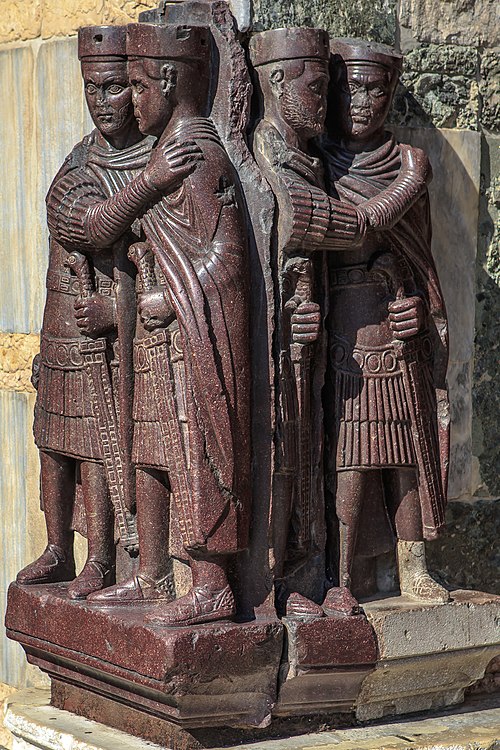
A late Roman sculpture depicting the four Tetrarchs, now in Venice, Italy

A coin of the Ostrogothic leader Theoderic the Great, struck in Milan, Italy, c. AD 491–501

A mosaic showing Justinian with the bishop of Ravenna (Italy), bodyguards, and courtiers.
High Middle Ages
Videos
Central EuropeGuelf, Hohenstaufen, and Ascanian domains in Germany about 1176
Middle Ages
…divisions of Western history: classical antiquity, the medieval period, and the modern period. The medieval period is itself subdivided into the Early, High, and Late Middle Ages. The Middle Ages began with the fall of the Western Roman Empire and transitioned into the Modern age during the Renaissance, the…

The Bayeux Tapestry depicting the Battle of Hastings during the Norman Conquest of 1066

Miniature representing the delivery of the fortress of Uclés to the Master of Order of Santiago in 1174

Holy Roman Emperor Frederick Barbarossa kneels before Pope Alexander III before signing the Treaty of Venice (1177), fresco in Palazzo Pubblico, Siena.

King Saint Stephen I of Hungary (Chronicon Pictum)