Middle East is a neighborhood in the heart of East Baltimore, Maryland.
Row homes in Middle East, June 2014.
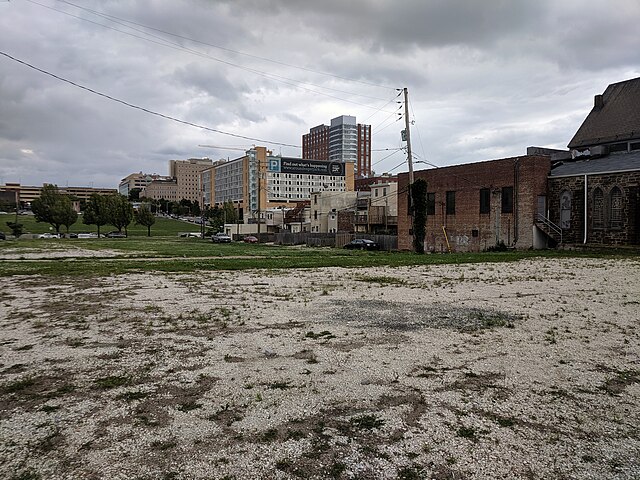
An empty field close to Johns Hopkins that once held a city block of rowhouses. The block was demolished to make way for a future Johns Hopkins-related development, May 2019.
St. Wenceslaus, June 2014.
History of Czechs in Baltimore
The history of Czechs in Baltimore dates back to the mid-19th century. Thousands of Czechs immigrated to East Baltimore during the late 19th and early 20th centuries, becoming an important component of Baltimore's ethnic and cultural heritage. The Czech community has founded a number of cultural institutions to preserve the city's Czech heritage, including a Roman Catholic church, a heritage association, a gymnastics association, an annual festival, a language school, and a cemetery. During the height of the Czech community in the late 19th century and early 20th century, Baltimore was home to 12,000 to 15,000 people of Czech birth or heritage. The population began to decline during the mid-to-late 20th century, as the community assimilated and aged, while many Czech Americans moved to the suburbs of Baltimore. By the 1980s and early 1990s, the former Czech community in East Baltimore had been almost entirely dispersed, though a few remnants of the city's Czech cultural legacy still remain.

Baltimore's former Little Bohemia, East Monument Historic District, June 2014.
Bohemian National Cemetery, Armistead Gardens, October 2012.
Eutaw Place Temple, a synagogue built by Temple Oheb Shalom, December 2011.
St. Athanasius Roman Catholic Church, in Curtis Bay, March 2018.