Minié rifle
Videos
The Minié rifle was a rifled musket used by the infantry of a number of countries in the mid-19th century. A version was adopted in Britain for a short time in 1851 but the French Army only officially

The Pattern 1853 Enfield and the Springfield Model 1861. Two prominent Minié rifles of the 19th century.
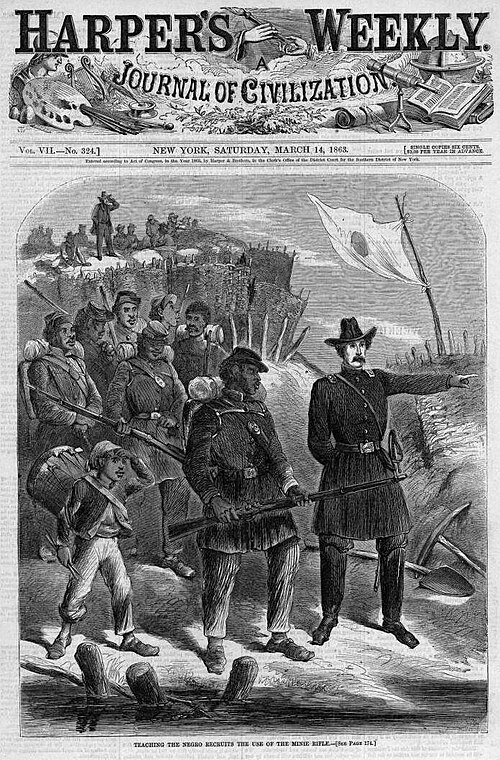
Training with the Minié rifle during the American Civil War, 1863. The caption reads: "Teaching the negro recruits the use of the Minié rifle"

French soldier stands with M1842T Minié rifle

The large, heavy bullet of the Minié rifle could cause devastating wounds
Minié ball
Videos
The Minié ball, or Minie ball, is a type of hollow-based bullet designed by Claude-Étienne Minié for muzzle-loaded, rifled muskets. Invented in 1849 shortly followed by the Minié rifle, the Minié ball
Minié rifle
…A version was adopted in Britain for a short time in 1851 but the French Army only officially adopted it in 1857. This came after the invention of the Minié ball in 1849 by the French Army captain Claude-Étienne Minié of the Chasseurs d'Orléans and Henri-Gustave Delvigne. The bullet was designed to allow rapid…

Various types of Minié balls. The four on the right are provided with Tamisier ball grooves for holding grease.

James H. Burton's 1855 Minié ball design (.58 caliber, 500 grains) from the Harpers Ferry Armory

Gunshot fracture of the left femur by a Minié ball, 1863

Private Milton E. Wallen of Company C, 1st Kentucky Cavalry, wounded by a Minié ball, while in prison at Richmond, July 4, 1863, being treated for gangrene