Monterey Canyon
Videos
Monterey Canyon, or Monterey Submarine Canyon, is a submarine canyon in Monterey Bay, California with steep canyon walls measuring a full 1 mile in height from bottom to top, which rivals the depth of

NOAA 3-D computer image depicting the Monterey Canyon system

MBUSGS
Turbidity current
Videos
A turbidity current is most typically an underwater current of usually rapidly moving, sediment-laden water moving down a slope; although current research indicates that water-saturated sediment may b
Monterey Canyon
…It is the largest submarine canyon along the West coast of the North American continent, and was formed by the underwater erosion process known as turbidity current erosion. Many questions remain unresolved regarding the exact nature of its origins, and as such it is the subject of several ongoing geological and marine…

Turbidites are deposited in the deep ocean troughs below the continental shelf, or similar structures in deep lakes, by turbidity currents which slide down the slopes.

Longitudinal section through an underwater turbidity current
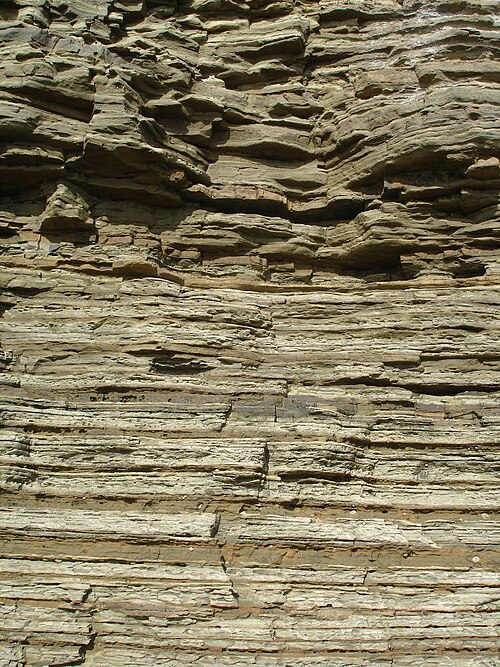
Turbidite interbedded with finegrained dusky-yellow sandstone and gray clay shale that occur in graded beds, Point Loma Formation, California.