Mosin–Nagant
Videos
The Mosin–Nagant is a five-shot, bolt-action, internal magazine–fed military rifle. Known officially as the 3-line rifle M1891, in Russia and the former Soviet Union as Mosin's rifle and informally ju
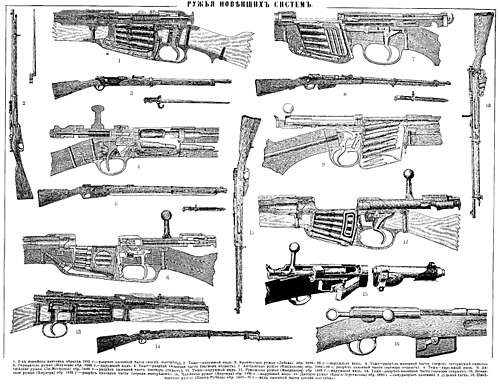
Schematic of Model 1891 (top left)

Russian Imperial infantry of World War I armed with Mosin–Nagant rifles

Arkhangelsk, Russia, November 20, 1918. The US 339th Infantry Regiment, equipped with Mosin-Nagant rifles, is inspected by British General Edmund Ironside, commander of the North Russia intervention Force.

A book published by the Japanese Army Magazine in 1938, quoted a Soviet Red Army military adviser's conversation, talking about the Mosin-Nagant sniper rifles (with a PE or PEM scope), which were used by the Chinese military in the Battle of Shanghai (1937), caused great losses to the Japanese army.
7.62×54mmR
Videos
The 7.62×54mmR is a rimmed rifle cartridge developed by the Russian Empire and introduced as a service cartridge in 1891. Originally designed for the bolt-action Mosin–Nagant rifle, it was used during
Mosin–Nagant
…as Mosin's rifle (Russian: винтовка Мосина, ISO 9: vintovka Mosina) and informally just mosinka (Russian: мосинка), it is primarily chambered for the 7.62×54mmR cartridge. Developed from 1882 to 1891, it was used by the armed forces of the Russian Empire, the Soviet Union and various other states. It is one of…

Examples of 7.62×54mmR rimmed ammunition. The photo shows, reading from left to right: Sellier & Bellot hollow-point boat tail; "Czech silver tip", mild steel core, light ball; Hungarian silver/yellow-tip, mild steel core, heavy ball; Wolf Ammunition gold soft-point; USSR 1986 steel-core light ball, Factory 60; Yugoslav surplus (1953); USSR 1940s lead-core light ball

Soviet World War II-era service cartridges: (Left to right) 7.62×54mmR, 7.62×39mm, 7.62×25mm

Modern service rifle cartridge cases: (Left to right) 7.62×54mmR, 7.62×51mm NATO, 7.62×39mm, 5.56×45mm NATO, 5.45×39mm

From left to right: L type bullet with lead core, LPS bullet with steel core aside, green tip T-46M tracer with tracer cup (opened both at top and bottom) and lead tip aside, T-46 tracer with extended cup (opened only at the bottom). All bullet jackets and tracer cups are made from copper washed steel.