Mount Mandara
Videos
Mandara is the name of the mountain that appears in the Samudra Manthana episode in the Hindu Puranas, where it was used as a churning rod to churn the Ocean of Milk. Shiva's serpent, Vasuki, offered

Kurma avatara of Vishnu, below Mount Mandara, with Vasuki wrapped around it, during Samudra Manthana, the churning of the Ocean of milk. ca 1870.

Depiction of Mandara used for the Churning of the Ocean
Dashavatara
Videos
The Dashavatara are the ten primary avatars of Vishnu, a principal Hindu god. Vishnu is said to descend in the form of an avatar to restore cosmic order. The word Dashavatara derives from daśa, meanin
Hindu god Vishnu (centre) surrounded by his ten major avatars (Krishna-Buddha version). Anticlockwise from top left: Matsya; Kurma; Varaha; Narasimha; Vamana; Parashurama; Rama; Krishna; Buddha and Kalki

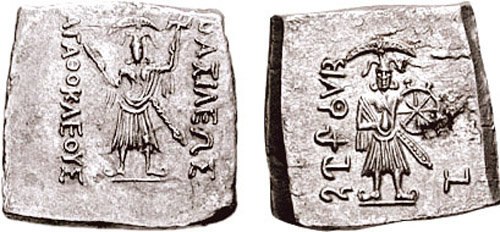
Balarama-Samkarshana, holding the gada and plough, and Vasudeva-Krishna, holding the sankha (a conch) and chakra, the half-brother avatars of Vishnu, are the earliest representations of avatars. Mint of the non-Hindu coinage of Agathocles, an Indo-Greek ruler, circa 185-170 BCE

Hindu god Vishnu's ten major avatars (Balarama-Krishna version) Dasavatara shrine, 18th century ivory (National Museum, New Delhi). From top descending: Matsya; Kurma; Varaha; Narasimha; Vamana; Parashurama; Rama; Balarama ; Krishna and Kalki.

1st to 5th of the Dashavataras on Udupi Sri Krishna Matha gopuram, Karnataka.