Mulberry harbours
Videos
The Mulberry harbours were two temporary portable harbours developed by the British Admiralty and War Office during the Second World War to facilitate the rapid offloading of cargo onto beaches during
View of the Mulberry B harbour "Port Winston" at Arromanches in September 1944. Centre and left are "spud" pierheads with floating piers of "whales" and "beetles". At right is 2,000 ft (610 m) of "Swiss roll".


Phoenix caissons under construction in Southampton in 1944

Aerial view of Mulberry harbour "B" at Arromanches-les-Bains in Normandy (October 27, 1944)

The remains of the harbour off Arromanches in 1990
Normandy landings
Videos
The Normandy landings were the landing operations and associated airborne operations on 6 June 1944 of the Allied invasion of Normandy in Operation Overlord during the Second World War. Codenamed Oper
Mulberry harbours
…Normandy in June 1944. They were designed in 1942, then built in under a year in great secrecy; within hours of the Allies creating beachheads after D-Day, sections of the two prefabricated harbours were towed across the English Channel from southern England and placed in position off Omaha Beach (Mulberry…

Into the Jaws of Death: men of the 16th Infantry Regiment wade ashore on Omaha Beach

Meeting of the Supreme Headquarters Allied Expeditionary Force (SHAEF), 1 February 1944. Front row: Air Chief Marshal Sir Arthur Tedder; General Dwight D. Eisenhower; General Sir Bernard Montgomery. Back row: Lieutenant General Omar Bradley; Admiral Sir Bertram Ramsay; Air Chief Marshal Sir Trafford Leigh-Mallory; Lieutenant General Walter Bedell Smith.

Shoulder patches were designed for units of the fictitious First United States Army Group under George Patton.
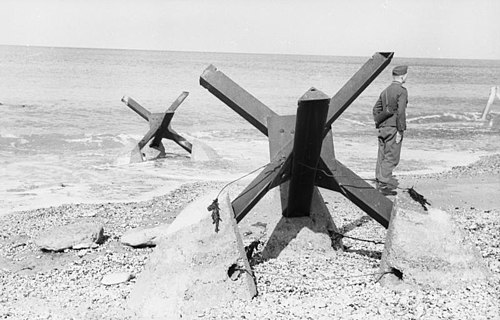
Czech hedgehogs deployed on the Atlantic Wall near Calais