Nana (echos)
Videos
Phthora nana is one of the ten modes of the Hagiopolitan Octoechos consisting of 8 diatonic echoi and two additional phthorai. It is used in different traditions of Orthodox chant until today. The name "nana" is taken from the syllables sung during the intonation which precedes a melody composed in this mode. The name "phthora" derived from the verb φθείρω and means "destroy" or "corrupt". It was usually referred to the diatonic genus of the eight mode system and as a sign used in Byzantine chant notation it indicated a "change to another genus", in the particular case of phthora nana a change to the enharmonic genus. Today the "nana" intonation has become the standard name of the third authentic mode which is called "echos tritos" in Greek and "third glas" in Old Church Slavonic.

Φθορά νανὰ as echos tritos in a 17th-century kekragarion (GB-Lbl Ms. Harley 5544, f. 35v)

"ἡ σοφωτάτη παραλλαγὴ κυρίου Ἰωάννου Ἰερέως τοῦ Πλουσιαδηνοῦ" in an 18th-century manuscript (Athos, Docheiariou monastery, Ms. 319, fol. 18v)

List of 7 phthorai used for transposition in a 17th-century Papadike (GB-Lbl Ms. Harley 5544, f. 5v).

Phthora atzem as a melos of echos tritos (Keltzanides 1881, 81)
Octoechos (liturgy)
Videos
The book Octoechos is a liturgical book containing a repertoire of hymns ordered in eight parts according to eight echoi. Originally created in the Monastery of Stoudios during the 9th century as a hymnal complete with musical notation, it is still used in many rites of Eastern Christianity. The book with similar function in the Western Church is the tonary, and both contain the melodic models of an octoechos system; however, while the tonary serves simply for a modal classification, the octoechos is organized as a cycle of eight weeks of services. The word itself can also refer to the repertoire of hymns sung during the celebrations of the Sunday Office.

Papyrus fragment of a 6th-century tropologion found in Egypt, marked in red are the modal signature and some early ekphonetic signs of the following theotokion ("another one") which is composed in a melos of echos plagios devteros (D-Bk P. 21319)
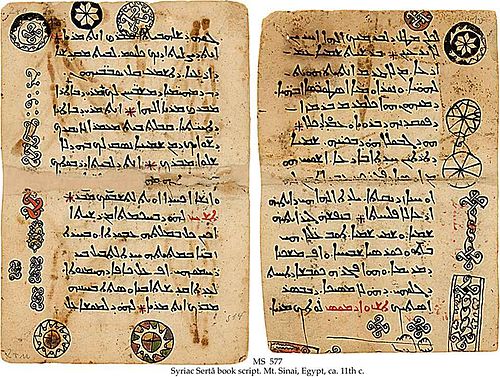
Melkite Heirmologion, written in Syriac language, using Sertâ book script at Saint Catherine's Monastery, Mount Sinai (11th century) Oslo, Schøyen Collection, Ms. 577.

Georgian Iadgari (tropologion, 10th century)

The first printed Octoechos (Schweipolt Fiol, Kraków 1491)