Nanban trade
Videos
Nanban trade is the European trade in Japan between the arrival of Europeans in 1543 to the first Sakoku Seclusion Edicts of isolationism in 1614.
First Westerners in Japan, by Hokusai, 1817. Caption: "On August 25, 1543, these foreigners were cast upon the island of Tanegashima, Ōsumi Province", followed by the two names Murashukusha (unknown) and Kirishitamōta (i.e. António da Mota, also known as Cristóvão, the Portuguese equivalent to Cristopher).


The samurai Hasekura Tsunenaga in Rome in 1615 (Coll. Borghese, Rome)

A Portuguese carrack in Nagasaki, 17th century.

Portuguese traders landing in Nagasaki
Dejima
Videos
Dejima or Deshima, in the 17th century also called Tsukishima, was an artificial island off Nagasaki, Japan, that served as a trading post for the Portuguese and subsequently the Dutch. For 220 years,
Nanban trade
…Sakoku policies that increasingly isolated mainland Japan from the outside world and limited European trade to Dutch traders on the artificial island of Dejima, under total scrutiny. Following contact with the Portuguese on Tanegashima in 1543, the Japanese were at first rather wary of the newly arrived…
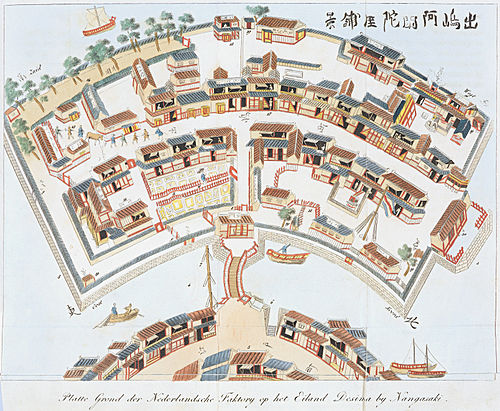
An imagined bird's-eye view of Dejima's layout and structures (copied from a woodblock print by Toshimaya Bunjiemon of 1780 and published in Isaac Titsingh's Bijzonderheden over Japan (1824/25)

A Dutchman with his servant at Dejima (18th-century painting by unknown artist, British Museum collection)

A 2017 model of Dejima in the Museum Volkenkunde in Leiden, Netherlands

A central part of reconstructed Dejima, Nagasaki, 2007