Nanshe
Videos
Nanshe was a Mesopotamian goddess in various contexts associated with the sea, marshlands, the animals inhabiting these biomes, namely bird and fish, as well as divination, dream interpretation, justi
Standing goddess, probably Nanshe. She is accompanied by two birds, possibly geese, and holds a vase in hand. Two streams of water and fish emerge from the vessel. Two six-pointed stars and two solar discs are behind the goddess. Ur III period.


Terracotta plaque showing seated goddess Nanshe and geese. from southern Iraq. 2003-1595 BCE. Iraq Museum

Foundation peg from the temple of goddess Nanshe at Sirara, rebuilt by Gudea. Bull calf in reed marsh. Circa 2130 BCE. Probably from Sirara, Iraq. The British Museum, London
Enki
Videos
Enki, also known as Ea, was the Mesopotamian god of wisdom, crafts, fresh subterranean waters, magic, and incantations. He was believed to rule the Abzû. In Mesopotamian astronomy, he was associated w
Nanshe
…and fish, as well as divination, dream interpretation, justice, social welfare, and certain administrative tasks. She was regarded as a daughter of Enki and sister of Ningirsu, while her husband was Nindara, who is otherwise little known. Other deities who belonged to her circle included her daughter…

Detail of Enki from the Adda Seal, an ancient Akkadian cylinder seal dating to circa 2,300 BCE

Old Babylonian (19th–17th century BCE) statue of Ea holding a vessel with flowing waters. Pergamon Museum.
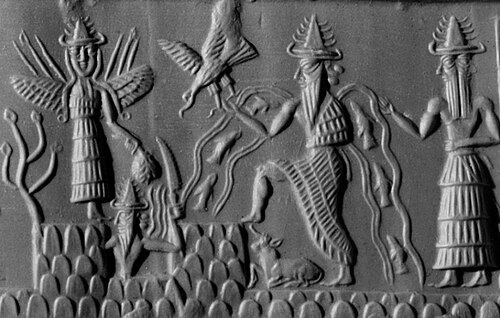
Detail of the Adda Seal, an ancient Akkadian cylinder seal (circa 2300 BCE) depicting Enki with water streams coming from his shoulders. British Museum.

Ea flanked by fish-cloaked apkallus. 7th century BCE. Pergamon Museum.