Napoleon
Videos
Napoleon Bonaparte, later known by his regnal name Napoleon I, was Emperor of the French from 18 May 1804 until his first abdication in 1814, with a brief restoration during the Hundred Days in 1815.


Napoleon's father, Carlo Buonaparte, fought for Corsican independence under Pasquale Paoli. After their defeat, he eventually became the island's representative to Louis XVI's court.

Bonaparte, aged 23, as lieutenant-colonel of a battalion of Corsican Republican volunteers. Portrait made in 1835 by Henri Félix Emmanuel Philippoteaux.

Bonaparte at the Siege of Toulon, 1793, by Édouard Detaille
Marie Louise was Duchess of Parma from 11 April 1814 until her death in 1847. She was Napoleon's second wife and as such Empress of the French and Queen of Italy from their marriage on 2 April 1810 un
Napoleon
…5 May 1821 (aged 51) Longwood, Saint Helena Burial 15 December 1840 Les Invalides, Paris, France Spouses Joséphine de Beauharnais (m. 1796; ann. 1810) Marie Louise of Austria (m. 1810; sep. 1814) Signature Napoleon Bonaparte (born Napoleone di Buonaparte; 15 August 1769 – 5 May 1821), later known by his regnal name Napoleon…

Portrait by Jean-Baptiste Paulin Guérin, c. 1812
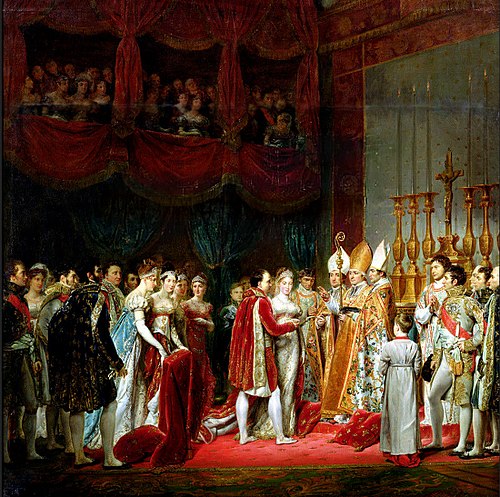
The Wedding of Napoleon and Marie Louise by Georges Rouget, 1810

Marie Louise with the King of Rome by Joseph Franque, 1811

Napoleon Bids Farewell to His Guard by Horace Vernet. In April 1814 Napoleon attempted to abdicate in favour of his son with Marie Louise as regent