Nationalism in the Middle Ages
Videos
Photos
Several scholars of nationalism support the existence of nationalism in the Middle Ages. This school of thought differs from modernism, the predominant school of thought on nationalism, which suggests that nationalism developed largely after the late 18th century and the French Revolution. Theories on the existence of nationalism in the Middle Ages may belong to the general paradigms of ethnosymbolism and primordialism (perennialism).

The Council of Constance (1414–1418) convened to end the Papal schism, which exacerbated growing nationalism in western Europe. At the Council representatives voted by "nations" as England, France and Germany, and later Spain. Painting by Vaclav Brozik, 1883.

The Carroccio (the sacred car) was a powerful symbol of the identity and honor of North Italian city-states during the civic nationalism period of mid 12th to 14th century. (Karatasli, p. 13). Here, reproduction of the Carroccio during the parade of the Palio di Legnano, 2015

Golden coin (hyperpyron) issued by Michael VIII Palaeologus to celebrate the liberation of Constantinople from the Latins, and the restoration of the Roman/Byzantine Empire.

Byzantine/Roman Emperor Theodore II Laskaris was a staunch supporter of the name Hellenes as a means of naming the empire and its inhabitants, as well as the first emperor to refer to the empire itself as Hellas
Early Cyrillic alphabet
Videos
Photos
The Early Cyrillic alphabet, also called classical Cyrillic or paleo-Cyrillic, is an alphabetic writing system that was developed in Medieval Bulgaria in the Preslav Literary School during the late 9th century. It is used to write the Church Slavonic language, and was historically used for its ancestor, Old Church Slavonic. It was also used for other languages, but between the 18th and 20th centuries was mostly replaced by the modern Cyrillic script, which is used for some Slavic languages, and for East European and Asian languages that have experienced a great amount of Russian cultural influence.

View of the cave monastery near the village of Krepcha, Opaka Municipality in Bulgaria. Here is the oldest Cyrillic inscription dated of 921.

The Cyrillic alphabet on birch bark document № 591 from ancient Novgorod (Russia). Dated to 1025–1050 AD.
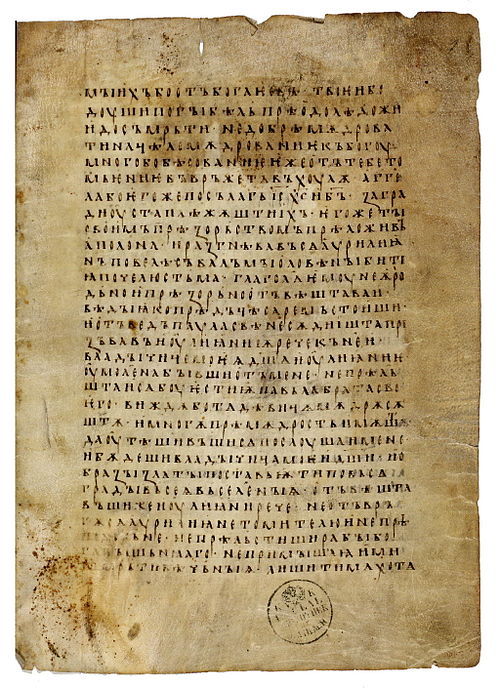
Codex Suprasliensis

Gospels of Tsar Ivan Alexander