Naval gunfire support
Videos
Naval gunfire support, also known as naval surface fire support, or shore bombardment, is the use of naval artillery to provide fire support for amphibious assault and other troops operating within th
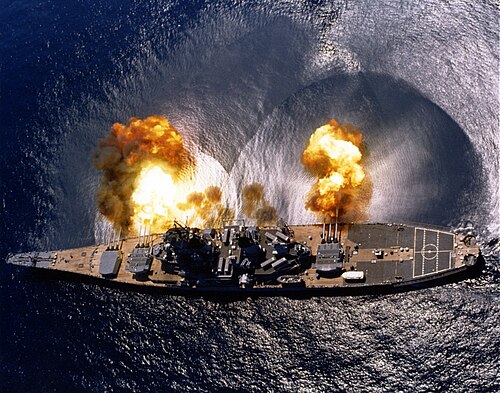
USS Iowa fires a full broadside of nine 16 in/50 and six 5 in/38 guns during a target exercise near Vieques Island, Puerto Rico, 1 July 1984.

The monitor HMS Marshal Ney, with her single turret trained to starboard (1915)

Stern view of HMS Lord Clive, her 18-inch gun is fitted on a fixed mounting on her quarterdeck, pointing to starboard (November 1918)

The WWI-era (launched 30 June 1917) United States Navy battleship USS Idaho shells Japanese defenses on Okinawa on 1 April 1945.
The United States battleship retirement debate was a debate among the United States Navy, Marine Corps, Congress, and independent groups over the effectiveness of naval gunfire support provided by Iow
Naval gunfire support
…The remaining naval artillery typically has more advanced targeting systems than the older large-caliber artillery. Within the U.S. there was a long debate over the role naval gunfire support should play in warfare. This took on a greater sense of urgency with the removal of the last two battleships from…

The battleship USS New Jersey fires at positions near Beirut on 9 January 1984 during the Lebanese Civil War.

USS Wisconsin, shown moored in Norfolk, Virginia, is one of four Iowa-class battleships open to the public as museums, and was one of two maintained for potential reactivation until 2009.

5-inch (127 mm) gun on an Arleigh Burke-class DDG

F4U-5 Corsairs provide close air support to U.S. Marines during the Battle of Chosin Reservoir, December 1950.