Nazario Benavídez
Videos
Photos
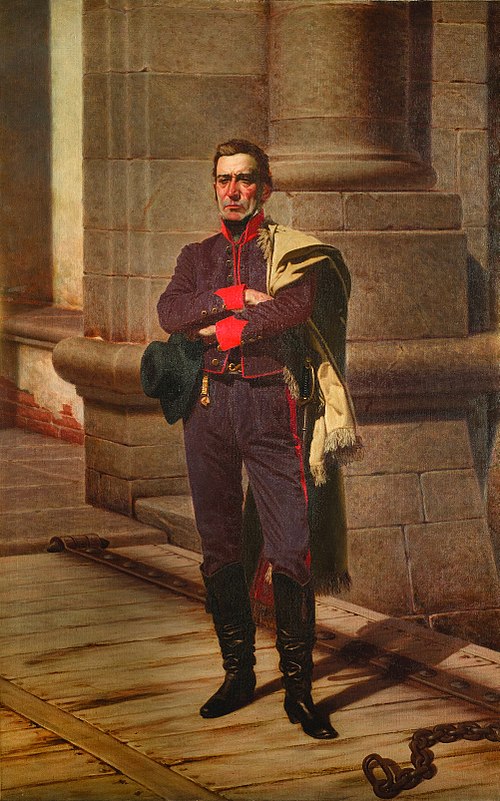
José Nazario Benavídez was an Argentine soldier who rose to the rank of Brigadier General and played a leading role in the Argentine Civil Wars. He was Governor of San Juan Province, Argentina, for almost twenty years in the mid-nineteenth century. His lengthy political career during a period of great turbulence was due to the great respect in which he was held by enemies as well as friends. After leaving office he was imprisoned and then murdered by his guards.

Oil portrait of Nazario Benavidez painted by Franklin Rawson, 1843

Facundo Quiroga, "El tigre de los llanos", Benavídez's commander and a witness at his wedding

Gregorio Aráoz de Lamadrid, a leader of the Unitarian forces

Justo José de Urquiza, whom Benavídez came to support
Argentine Civil Wars
Videos
Photos
The Argentine Civil Wars were a series of civil conflicts of varying intensity that took place through the territories of Argentina from 1814 to 1853. Beginning concurrently with the Argentine War of Independence (1810–1818), the conflict prevented the formation of a stable governing body until the signing of the Argentine Constitution of 1853, followed by low-frequency skirmishes that ended with the Federalization of Buenos Aires.
The period saw heavy intervention from the Brazilian Empire that fought against state and provinces in multiple wars. Breakaway nations, former territories of the viceroyalty, such as the Banda Oriental, Paraguay and the Upper Peru were involved to varying degrees. Foreign powers such as the British and French empires put heavy pressure on the fledgling nations at times of international war.

From top left: Battle of Arroyo Grande, execution of Manuel Dorrego, Battle of Pavón, death of Juan Lavalle, murder of Facundo Quiroga, Battle of Caseros, Battle of Famaillá, Battle of Vuelta de Obligado
The Banda Oriental, under the liberator José Gervasio Artigas, defended the federal system until all the provinces had equal conditions.

Buenos Aires Governor Juan Manuel de Rosas secured the Confederation under Federalist rule.

A Rosas-era banner calling for "death to the brutal Unitarians" typified the ongoing conflict