Nebra or Raneb is the Horus name of the second early Egyptian king of the 2nd Dynasty. The exact length of his reign is unknown since the Turin canon is damaged and the year accounts are lost. Manetho suggests that Nebra's reign lasted 39 years, but Egyptologists question Manetho's view as a misinterpretation or exaggeration of information that was available to him. They credit Nebra with either a 10- or 14-year rule.
Tomb stela of Nebra, Metropolitan Museum of Art, New York
Statue of Hotepdief, priest of the mortuary cults of the first 3 rulers of the dynasty, Hotepsekhemwy, Nebra and Nynetjer. The serekh of Nebra is the middle one on the shoulder of the priest.
Cartouche name of Nebra in the Abydos King List, read as k3 k3w(kakau) (cartouche no. 10)
Pharaoh is the vernacular term often used for the monarchs of ancient Egypt, who ruled from the First Dynasty until the annexation of Egypt by the Roman Republic in 30 BCE. However, regardless of gender, "king" was the term used most frequently by the ancient Egyptians for their monarchs through the middle of the Eighteenth Dynasty during the New Kingdom. The earliest confirmed instances of "pharaoh" used contemporaneously for a ruler were a letter to Akhenaten or an inscription possibly referring to Thutmose III.
The Mask of Tutankhamun from tomb KV62 in the Valley of the Kings. Pharaohs' tombs were provided with vast quantities of wealth
A guardian statue wearing the red crown which reflected the facial features of the reigning king, probably Amenemhat II or Senwosret II, and which functioned as a divine guardian for the imiut. Made of cedar wood and plaster c. 1919–1885 BCE
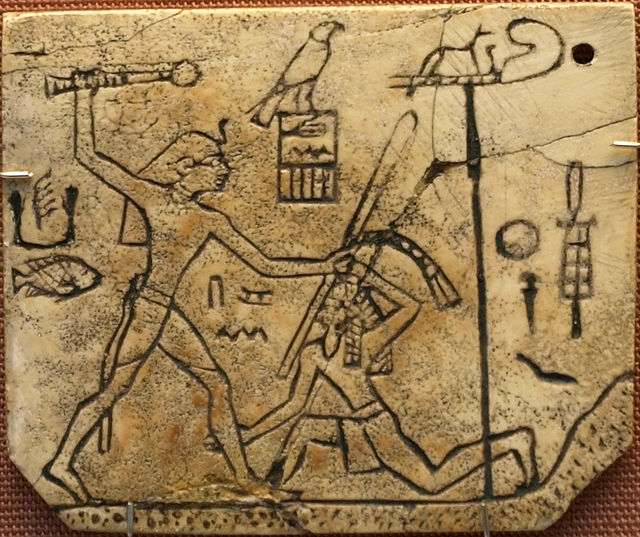
Uraeus depicted on king Den, ivory label found at his tomb in Abydos, c. 3000 BCE, British Museum, London
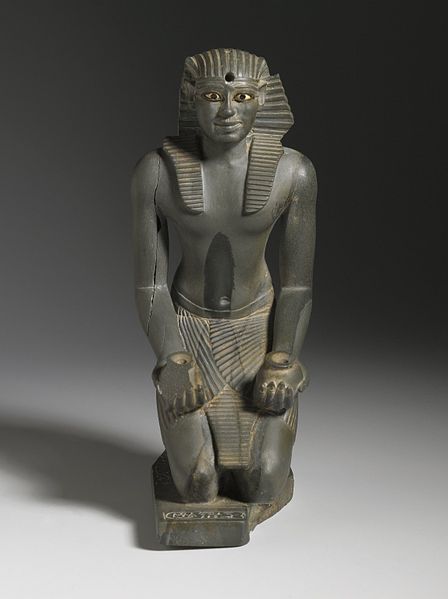
Statuette of Pepy I (c. 2338-2298 BCE) wearing a nemes headdress Brooklyn Museum, New York