Nigger in the woodpile
Videos
"Nigger in the woodpile" or "nigger in the fence" is a figure of speech originating in the United States meaning "some fact of considerable importance that is not disclosed—something suspicious or wro

A Democratic Party parody, titled "'The Nigger' in the Woodpile", lampooned what they said were Republican efforts to play down the antislavery plank in their 1860 platform. Republican candidate Abraham Lincoln, who had worked as a laborer splitting wooden rails as a young man, is sitting on top of the pile. Illustration believed to have been drawn by Louis Maurer.

Dr. Seuss's cartoon "Cross-Section of The World's Most Prosperous Department Store"
Nigger
Videos
Nigger is a racial slur directed at Black people. References to nigger have been increasingly replaced by the euphemism "the N-word", notably in cases where nigger is mentioned but not directly used.
Nigger in the woodpile
…or wrong". Commonly used in the late 19th and early 20th centuries, its usage has since drastically declined, owing to its use of the ethnic slur nigger, and use of the phrase by public figures has often been criticized because of the usage of the slur in the term. The phrase means an unknown factor…
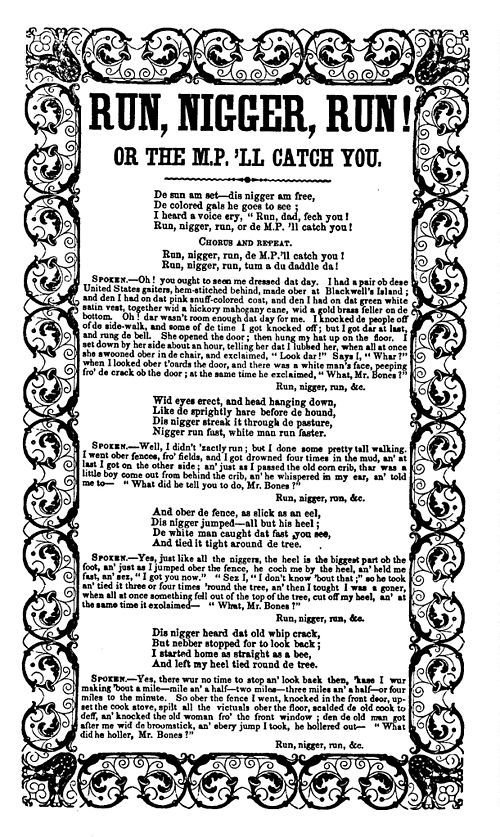
Lyrics for the song "Run, Nigger, Run", about a fugitive slave escaping from a slave patrol, printed in 1851

The US edition of Joseph Conrad's The Nigger of the "Narcissus" was called The Children of the Sea.

Historical American cartoon titled "Why the nigger is not fit to vote", by Thomas Nast, arguing the reason Democrats objected to African-Americans having the vote was that, in the 1868 US presidential election, African-Americans voted for the Republican candidates Ulysses S. Grant and Schuyler Colfax. "Seymour friends meet here" in the background is a reference to the Democratic Party candidate: Horatio Seymour.

1885 illustration from Mark Twain's Adventures of Huckleberry Finn, captioned "Misto Bradish's nigger"