Ningishzida
Videos
Ningishzida was a Mesopotamian deity of vegetation, the underworld and sometimes war. He was commonly associated with snakes. Like Dumuzi, he was believed to spend a part of the year in the land of th
Ningishzida, with snakes emanating from his shoulders, on a relief of Gudea, c. 2000 BCE


Ningishzida on the libation vase of Gudea, circa 2100 BCE

The "libation vase of Gudea" with the dragon Mušḫuššu, dedicated to Ningishzida, circa 2100 BCE (short chronology). The caduceus-like symbol (right) is interpreted as a representation of the god himself. Inscription: "To the god Ningiszida, his god, Gudea, Ensi (governor) of Lagash, for the prolongation of his life, has dedicated this"

The name Ningishzida inscribed on a statue of Ur-Ningirsu.
Geshtinanna
Videos
Geshtinanna was a Mesopotamian goddess best known due to her role in myths about the death of Dumuzi, her brother. It is not certain what functions she fulfilled in the Mesopotamian pantheon, though h
Ningishzida
…An = Anum listing two, Azimua (elsewhere also called Ninazimua) and Ekurritum (not attested in such a role anywhere else), while other sources favor Geshtinanna, identified with Belet-Seri. However, Azimua shared Gesthinanna's role as an underworld scribe,and her name could also function as a title of Geshtinanna…

Fragment of a marble bowl from Uruk inscribed with the name of Geshtinanna, currently housed in the British Museum

An Old Babylonian tablet inscribed with a lamentation over the death of Dumuzi, currently in the collection of Louvre Museum
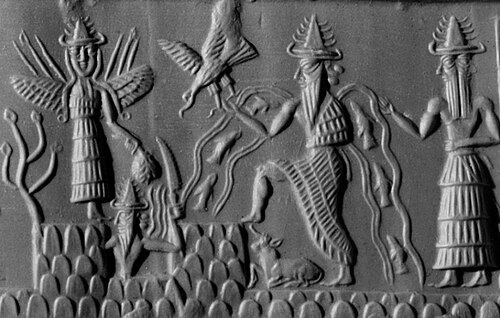
Ea En Ki