Nocturnal bottleneck
Videos
The nocturnal bottleneck hypothesis is an evolutionary biology hypothesis to explain the origin of several mammalian traits. In 1942, Gordon Lynn Walls described this concept which states that placent

Artist's impression of the Purbeck lagoon at dusk: Durlstotherium (right and center foreground) and Durlstodon (left foreground) ventured out at night to hunt insects. The theropod Nuthetes is holding a captured Durlstotherium (centre middle distance).

The flash of a camera causes glare reflected by the tapetum lucidum within the eyes of a European badger. The tapetum is one of many traits adapted for nocturnal life that are commonly found in mammals.

Brasilitherium, a near-mammalian cynodont, was probably a nocturnal burrower.

The whiskers on a shrew, used in finding prey, navigation and socialization
Mammal
Videos
A mammal is a vertebrate animal of the class Mammalia. Mammals are characterized by the presence of milk-producing mammary glands for feeding their young, a broad neocortex region of the brain, fur or
Nocturnal bottleneck
…The nocturnal bottleneck hypothesis is an evolutionary biology hypothesis to explain the origin of several mammalian traits. In 1942, Gordon Lynn Walls described this concept which states that placental mammals were mainly or even exclusively nocturnal through most…
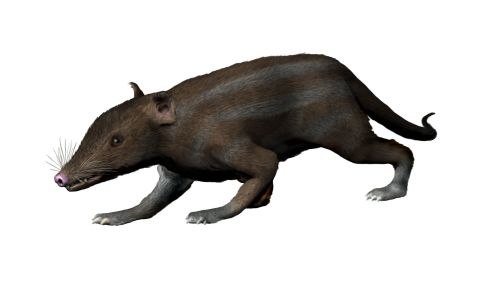
Restoration of Juramaia sinensis, the oldest-known eutherian (160 mya)

Fossil of Thrinaxodon at the National Museum of Natural History
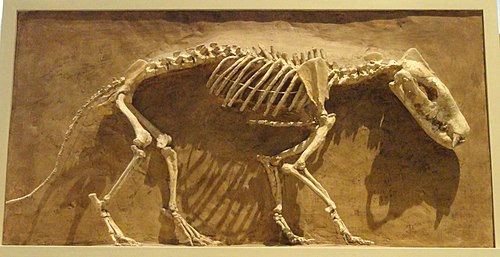
Hyaenodon horridus at the Royal Ontario Museum. The genus Hyaenodon was among the most successful mammals of the late Eocene-early Miocene epochs spanning for most of the Paleogene and some of the Neogene periods, undergoing many endemic radiations in North America, Europe, and Asia.

Sexual dimorphism in aurochs, the extinct wild ancestor of cattle