The Noronha skink is a species of skink from the island of Fernando de Noronha off northeastern Brazil. It is covered with dark and light spots on the upperparts and is usually about 7 to 10 cm in length. The tail is long and muscular, but breaks off easily. Very common throughout Fernando de Noronha, it is an opportunistic feeder, eating both insects and plant material, including nectar from the Erythrina velutina tree, as well as other material ranging from cookie crumbs to eggs of its own species. Introduced predators such as feral cats prey on it and several parasitic worms infect it.
Noronha skink
Noronha skinks are very common on Fernando de Noronha.
Noronha skinks bask in the sun for thermoregulation.
Insects form an important part of the diet of the Noronha skink.
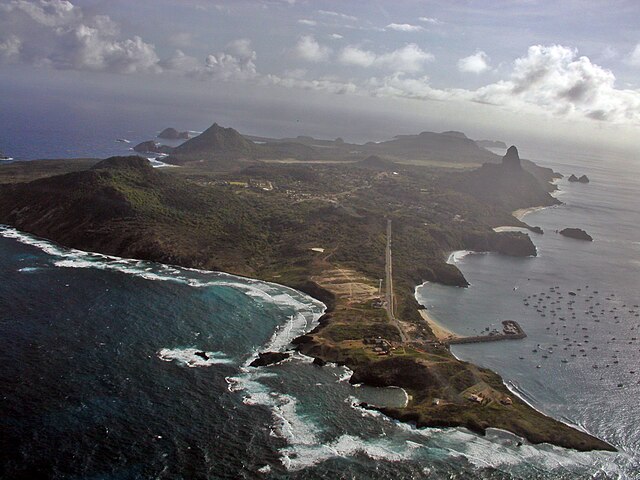
Fernando de Noronha, officially the State District of Fernando de Noronha and formerly known as the Territory of Fernando de Noronha until 1988, is an archipelago in the Atlantic Ocean, part of the State of Pernambuco, Brazil, and located 354 km off the Brazilian coast. It consists of 21 islands and islets, extending over an area of 26 km2 (10 sq mi). Only the eponymous main island is inhabited; it has an area of 18.4 km2 (7.1 sq mi) and a population estimated at 3,101 in 2020. While most of the archipelago is relatively low-lying, there are parts reaching more than 100 m (328 ft) in elevation.
Do Meio and Conceição beaches
The main island
Morro Dois Irmãos
Satellite picture of Fernando de Noronha