North Vietnam
Videos
The Democratic Republic of Vietnam was a country in Southeast Asia from 1945 to 1976, with sovereignty recognized in July 1954, after which it became commonly known as North Vietnam. A member of the c
Ho Chi Minh declaring independence at Ba Dinh Square on September 2nd, 1945


The DRV coalition government in early 1946

First Nationwide Congress of Emulation Fighters, 1952

Ho Chi Minh (seated, right) with Tôn Đức Thắng (seated, left) and other DRV leaders in a liberated zone of northern Vietnam during the First Indochina War.
Vietnam War
Videos
The Vietnam War was an armed conflict in Vietnam, Laos, and Cambodia fought between North Vietnam and South Vietnam and their allies. North Vietnam was supported by the Soviet Union and China, while S
North Vietnam
…Chief of State Bảo Đại and established the Republic of Vietnam with Diệm as its first president. Failure to unify the country by referendum led to the Vietnam War in 1955. Supported by their communist allies, mainly China and the Soviet Union, the northern People's Army of Vietnam and the southern National…

U.S. Army UH 1H Hueys insert ARVN troops at Khâm Đức, Vietnam, 12 July 1970

Pavnbattle
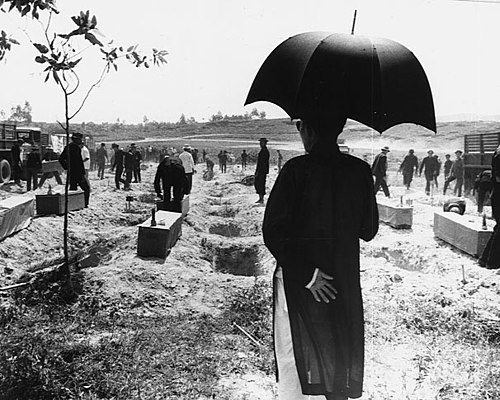
Hue Massacre Interment

Bombing in Vietnam