Nunatak
Videos
A nunatak is the summit or ridge of a mountain that protrudes from an ice field or glacier that otherwise covers most of the mountain or ridge. They often form natural pyramidal peaks. Isolated nunata

Nunataks in Antarctica

Cântaro Magro, Serra da Estrela, Portugal, formed as a nunatak during the last ice age and now exposed.
Glacier
Videos
A glacier is a persistent body of natural ice, a form of rock, that is constantly moving under its own weight. A glacier forms where the accumulation of snow exceeds its ablation over many years, ofte
Nunatak
…A nunatak (from Inuit nunataq) is the summit or ridge of a mountain that protrudes from an ice field or glacier that otherwise covers most of the mountain or ridge. They often form natural pyramidal peaks. Isolated nunataks are also called glacial islands, and…

Glacier of the Geikie Plateau in Greenland

The Taschachferner in the Ötztal Alps in Austria. The mountain to the left is the Wildspitze (3,768 m), the second highest in Austria

The Baltoro Glacier in Pakistan. It is 62 kilometres (39 mi) long, the fifth longest alpine glacier in the world.
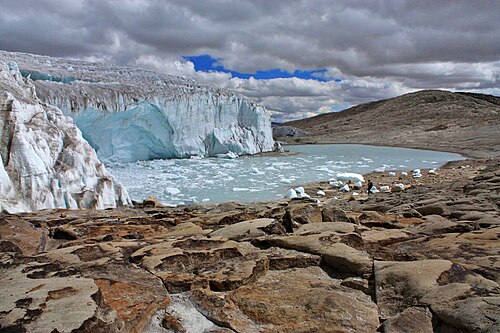
The Quelccaya Ice Cap in Peru is the second-largest glaciated area in the tropics