Nymphaeum (Olympia)
Videos
Photos
Nymphaeum (Olympia) (Latin, Ancient Greek: νυμφαῖον), etymologically "home of the nymphs," or water goddesses, at ancient Olympia was the official name of a water-distribution structure constructed in the mid-2nd century at that site to provide water to the masses who attended the Olympic Games in July and August. Nymphaeum was the general name throughout the Mediterranean for an ornate structure that terminated an aqueduct bringing water from distant elevated terrain, say a stream or copious springs. This one had substructures, statues, and ornately patterned stonework; its main purpose, however, was functional. It received water from the aqueduct into a cistern and released it by stages into a system of open and closed channels leading around the site. The end partaker of the water carried a secular patera, or small drinking bowl, around with him, dipping into an open trough for the water, as is suggested by the fact that at least some of the statues carried such paterae in one hand (though they may also have been performing libations). Troughs went everywhere through the site to accommodate the crowds.

Ruins of the Nymphaeum at Olympia seen from below. The lowest stage was an open trough leading throughout the site, into which the thirsty or overheated person dipped his patera, or drinking bowl.

Roman public latrine in the thermae of Ephesus

Herodes Atticus, Louvre

Lion-head spout from Olympia
Olympia, Greece
Videos
Photos
Olympia, officially Archaia Olympia, is a small town in Elis on the Peloponnese peninsula in Greece, famous for the nearby archaeological site of the same name. This site was a major Panhellenic religious sanctuary of ancient Greece, where the ancient Olympic Games were held every four years throughout Classical antiquity, from the 8th century BC to the 4th century AD. They were restored on a global basis in 1894 in honor of the ideal of peaceful international contention for excellence.

View of the Palestra, a center for wrestling

The archaeological site showing the stadium, the temple of Hera, the temple of Zeus. The line of trees, upper right, border a road to the north of the Alfeios. Geologically the site is terraced into the gentle north slope of the Alfeios valley visible in the background.

Peribolos wall remains seen in the foreground from the south against the backdrop of the Temple of Hera
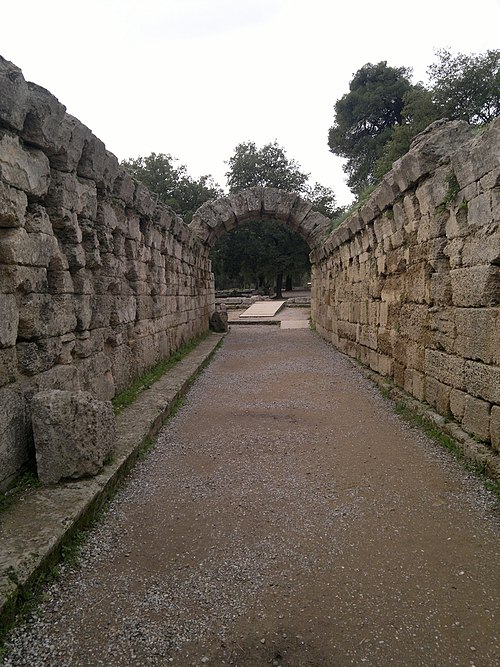
Crypt (arched way to the stadium)