Oil print process
Videos
Photos
The oil print process is a photographic printmaking process that dates to the mid-19th century. Oil prints are made on paper on which a thick gelatin layer has been sensitized to light using dichromate salts. After the paper is exposed to light through a negative, the gelatin emulsion is treated in such a way that highly exposed areas take up an oil-based paint, forming the photographic image.

Oil print by Robert Demachy – A Crowd, 1910

Bromoil portrait of the Norwegian painter Andreas Jacobsen. Made by Erik Hattrem from 4x5" Kodak plus-x on Fomabrom IV123 paper

Bromoil print by Josef Jindřich Šechtl, 1920s

Goldbandlilie, 1932, a 4-color bromoil-transfer by F. Rontag
Pictorialism
Videos
Photos
Pictorialism is an international style and aesthetic movement that dominated photography during the later 19th and early 20th centuries. There is no standard definition of the term, but in general it refers to a style in which the photographer has somehow manipulated what would otherwise be a straightforward photograph as a means of creating an image rather than simply recording it. Typically, a pictorial photograph appears to lack a sharp focus, is printed in one or more colors other than black-and-white and may have visible brush strokes or other manipulation of the surface. For the pictorialist, a photograph, like a painting, drawing or engraving, was a way of projecting an emotional intent into the viewer's realm of imagination.

"The Black Bowl", by George Seeley, circa 1907. Published in Camera Work, No 20 (1907)

"The Rose", by Eva Watson-Schütze, 1905

"Fading Away", by Henry Peach Robinson, 1858
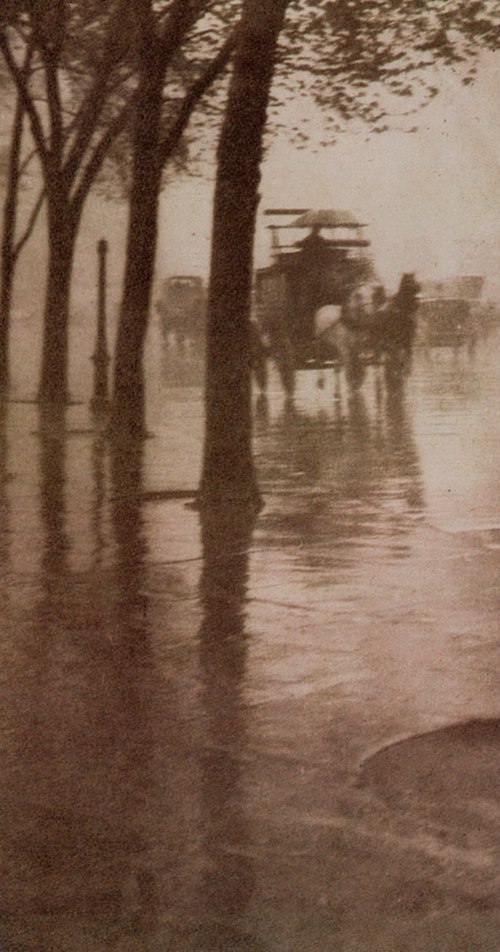
"Spring Showers, the Coach", by Alfred Stieglitz, 1899-1900