Old Persian cuneiform
Videos
Old Persian cuneiform is a semi-alphabetic cuneiform script that was the primary script for Old Persian. Texts written in this cuneiform have been found in Iran, Armenia, Romania, Turkey, and along th
Tomb of Darius I D Na inscription part II


Cuneiform inscriptions recorded by Jean Chardin in Persepolis in 1674 (1711 edition)

This Old Persian cuneiform sign sequence, because of its numerous occurrences in inscriptions, was correctly guessed by Münter as being the word for "King". This word is now known to be pronounced xšāyaθiya in Old Persian (𐎧𐏁𐎠𐎹𐎰𐎡𐎹), and indeed means "King".

Niebuhr inscription 1, with the suggested words for "King" (𐎧𐏁𐎠𐎹𐎰𐎡𐎹) highlighted. Inscription now known to mean "Darius the Great King, King of Kings, King of countries, son of Hystaspes, an Achaemenian, who built this Palace". Today known as DPa, from the Palace of Darius in Persepolis, above figures of the king and attendants
Old Persian
Videos
Old Persian is one of two directly attested Old Iranian languages and is the ancestor of Middle Persian. Like other Old Iranian languages, it was known to its native speakers as ariya. Old Persian is
Old Persian cuneiform
…Old Persian cuneiform is a semi-alphabetic cuneiform script that was the primary script for Old Persian. Texts written in this cuneiform have been found in Iran (Persepolis, Susa, Hamadan, Kharg Island), Armenia, Romania (Gherla), Turkey (Van Fortress…
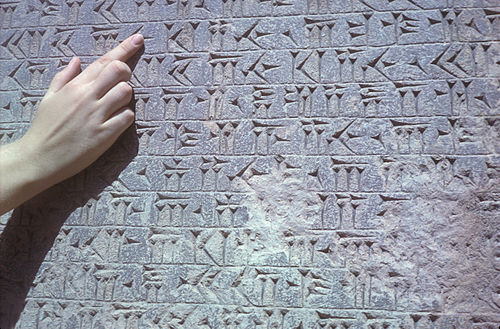
Close-up of the Behistun inscription
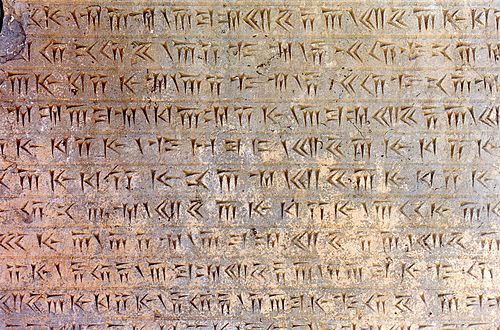
An Old Persian inscription in Persepolis